Skip to main content
Contents Dark Mode Prev Up Next \(\newcommand{\abs}[1]{\left\lvert #1 \right\rvert}
\newcommand{\set}[1]{\left\{ #1 \right\}}
\renewcommand{\neg}{\sim}
\newcommand{\brac}[1]{\left( #1 \right)}
\newcommand{\eval}[1]{\left. #1 \right|}
\newcommand{\Area}[1]{\operatorname{Area}\left( #1 \right)}
\newcommand{\vecii}[2]{\left\langle #1, #2 \right\rangle}
\newcommand{\veciii}[3]{\left\langle #1, #2, #3 \right\rangle}
\renewcommand{\vec}[1]{\mathbf{#1}}
\newcommand{\N}{\mathbb N}
\newcommand{\Z}{\mathbb Z}
\newcommand{\Q}{\mathbb Q}
\newcommand{\R}{\mathbb R}
\DeclareMathOperator{\sgn}{sgn}
\DeclareMathOperator{\csch}{csch}
\DeclareMathOperator{\sech}{sech}
\DeclareMathOperator{\arcsec}{arcsec}
\DeclareMathOperator{\arccot}{arccot}
\DeclareMathOperator{\arccsc}{arccsc}
\newcommand{\lt}{<}
\newcommand{\gt}{>}
\newcommand{\amp}{&}
\definecolor{fillinmathshade}{gray}{0.9}
\newcommand{\fillinmath}[1]{\mathchoice{\colorbox{fillinmathshade}{$\displaystyle \phantom{\,#1\,}$}}{\colorbox{fillinmathshade}{$\textstyle \phantom{\,#1\,}$}}{\colorbox{fillinmathshade}{$\scriptstyle \phantom{\,#1\,}$}}{\colorbox{fillinmathshade}{$\scriptscriptstyle\phantom{\,#1\,}$}}}
\)
Section 6.6 Inverse Trigonometric Substitution
Inverse trigonometric substitution is a technique used to evaluate integrals that contain expressions of the form
\(\sqrt{a^2 - x^2}\text{,}\) \(\sqrt{x^2 - a^2}\text{,}\) or
\(\sqrt{a^2 + x^2}\text{.}\) This method uses trigonometric identities to simplify these integrals.
Subsection 6.6.1 Summary of Inverse Trigonometric Substitution
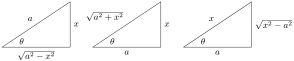
Table 6.6.1.
\(\text{form}\) \(\text{substitution}\) \(\text{conversion}\) \(\text{triangle}\)
\(\sqrt{a^2 - x^2}\) \(x = a \sin{\theta}\) \(\sqrt{a^2 - x^2} \rightarrow a \cos{\theta}\) \(\sqrt{a^2 - x^2}, x, a\)
\(\sqrt{a^2 + x^2}\) \(x = a \tan{\theta}\) \(\sqrt{a^2 + x^2} \rightarrow a \sec{\theta}\) \(x, a, \sqrt{a^2 + x^2}\)
\(\sqrt{x^2 - a^2}\) \(x = a \sec{\theta}\) \(\sqrt{x^2 - a^2} \rightarrow a \tan{\theta}\) \(\sqrt{x^2 - a^2}, a, x\)
Identify the form of the substitution (sine, tangent, or secant).
Apply the substitution. Sketch a right triangle and label the sides, to represent the relationships between \(x, a\) and \(\theta\text{.}\)
Simplify the integral.
Integrate with the new variable \(\theta\text{,}\) using previous strategies, typically a trigonometric integral.
Back-substitute using the inverse trigonometric function to substitute back for \(x\text{.}\)
Subsection 6.6.2 Examples
Checkpoint 6.6.2 . Example.
Evaluate
\(\int \frac{x^2}{\sqrt{9-x^2}} \,dx\text{.}\)
Hint .
Let
\(x = 3 \sin{\theta}\text{,}\) so
\(dx = 3 \cos{\theta} \,d\theta\text{.}\)
Answer .
\begin{gather*}
\frac{9}{2} \sin^{-1}\brac{\frac{x}{3}} - \frac{1}{2} x \sqrt{9-x^2} + C
\end{gather*}
Solution .
\begin{align*}
\amp = \int \frac{(3 \sin{\theta})^2}{3 \cos{\theta}} \cdot 3 \cos{\theta} \,d\theta\\
\amp = 9 \int \sin^2{\theta} \,d\theta\\
\amp = ...\\
\amp = \frac{9}{2} \sin^{-1}\brac{\frac{x}{3}} - \frac{1}{2} x \sqrt{9-x^2} + C
\end{align*}
Checkpoint 6.6.3 . Example.
Determine
\begin{gather*}
\int \frac{1}{x^2 \sqrt{4 + x^2}} \,dx
\end{gather*}
Checkpoint 6.6.4 . Example.
Determine
\begin{gather*}
\int \frac{1}{(1 + 9x^2)} \,dx
\end{gather*}
Checkpoint 6.6.5 . Example.
Determine
\begin{gather*}
\int \frac{\sqrt{x^2 - 25}}{x} \,dx
\end{gather*}
Checkpoint 6.6.6 .
Evaluate
\begin{gather*}
\int \frac{\sqrt{x^2 - 1}}{x^4} \,dx
\end{gather*}
Checkpoint 6.6.7 .
Evaluate
\begin{gather*}
\int \frac{\sqrt{25x^2 - 4}}{x} \,dx
\end{gather*}
Checkpoint 6.6.8 .
Evaluate
\begin{gather*}
\int \frac{\sqrt{x^2+16}}{x^2} \,dx
\end{gather*}
Checkpoint 6.6.9 .
Evaluate
\begin{gather*}
\int \frac{x}{\sqrt{9-4x^2}} \,dx
\end{gather*}
Checkpoint 6.6.10 .
Evaluate
\begin{gather*}
\int \frac{1}{\sqrt{25x^2-4}} \,dx
\end{gather*}
Checkpoint 6.6.11 .
Evaluate
\begin{gather*}
\int \frac{1}{x^2 \sqrt{x^2-1}} \,dx
\end{gather*}
Checkpoint 6.6.12 .
Evaluate
\begin{gather*}
\int \frac{8}{(4x^2+1)^2} \,dx
\end{gather*}