Skip to main content
Contents Dark Mode Prev Up Next \(\newcommand{\abs}[1]{\left\lvert #1 \right\rvert}
\newcommand{\set}[1]{\left\{ #1 \right\}}
\renewcommand{\neg}{\sim}
\newcommand{\brac}[1]{\left( #1 \right)}
\newcommand{\eval}[1]{\left. #1 \right|}
\newcommand{\Area}[1]{\operatorname{Area}\left( #1 \right)}
\newcommand{\vecii}[2]{\left\langle #1, #2 \right\rangle}
\newcommand{\veciii}[3]{\left\langle #1, #2, #3 \right\rangle}
\renewcommand{\vec}[1]{\mathbf{#1}}
\newcommand{\N}{\mathbb N}
\newcommand{\Z}{\mathbb Z}
\newcommand{\Q}{\mathbb Q}
\newcommand{\R}{\mathbb R}
\DeclareMathOperator{\sgn}{sgn}
\DeclareMathOperator{\csch}{csch}
\DeclareMathOperator{\sech}{sech}
\DeclareMathOperator{\arcsec}{arcsec}
\DeclareMathOperator{\arccot}{arccot}
\DeclareMathOperator{\arccsc}{arccsc}
\newcommand{\lt}{<}
\newcommand{\gt}{>}
\newcommand{\amp}{&}
\definecolor{fillinmathshade}{gray}{0.9}
\newcommand{\fillinmath}[1]{\mathchoice{\colorbox{fillinmathshade}{$\displaystyle \phantom{\,#1\,}$}}{\colorbox{fillinmathshade}{$\textstyle \phantom{\,#1\,}$}}{\colorbox{fillinmathshade}{$\scriptstyle \phantom{\,#1\,}$}}{\colorbox{fillinmathshade}{$\scriptscriptstyle\phantom{\,#1\,}$}}}
\)
Section 5.1 L’Hopital’s Rule
Subsection 5.1.1 L’Hopital’s Rule Summary
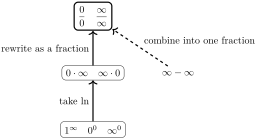
Determine if the limit is an indeterminate form, and if so, then what form it is.
If it’s
\(\frac{0}{0}\) or
\(\frac{\infty}{\infty}\text{,}\) then apply L’Hopital’s rule directly.
If it’s
\(0 \cdot \infty\) (or
\(\infty \cdot 0\) ), flip one of the terms to convert it to
\(\frac{0}{0}\) or
\(\frac{\infty}{\infty}\) (whichever is more convenient).
If it’s
\(\infty - \infty\text{,}\) then write it as one fraction first, and then continue.
If it’s an indeterminate form with an exponent, like
\(1^{\infty}\text{,}\) \(0^0\text{,}\) or
\(\infty^0\text{,}\) then first use logarithms.