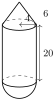
An ice cream cone has radius 3 cm and height 12 cm. A hemispherical scoop of ice cream (same radius) sits on top. Find the total volume and the total outer surface area.
Volume: The cone volume is,
\begin{equation*}
V_{\text{cone}} = \frac{1}{3}\pi(3)^2(12) = \frac{108\pi}{3} = 36\pi
\end{equation*}
The hemisphere volume is,
\begin{equation*}
V_{\text{hemisphere}} = \frac{2}{3}\pi(3)^3 = 18\pi
\end{equation*}
Total volume:
\(V = 36\pi + 18\pi = 54\pi \approx 169.6 \text{ cm}^3\text{.}\)
Surface area: The outer surface consists of the lateral surface of the cone and the curved surface of the hemisphere. The circular face where they join is hidden (not part of the outer surface).
First, find the slant height of the cone:
\(s = \sqrt{3^2 + 12^2} = \sqrt{9 + 144} = \sqrt{153} \approx 12.37\) cm.
\begin{align*}
SA_{\text{lateral cone}} \amp= \pi r s = \pi(3)\sqrt{153} = 3\sqrt{153}\,\pi\\
SA_{\text{curved hemisphere}} \amp= 2\pi r^2 = 2\pi(9) = 18\pi
\end{align*}
Total outer SA:
\(SA = 3\sqrt{153}\,\pi + 18\pi \approx 116.6 + 56.5 \approx 173.2 \text{ cm}^2\text{.}\)