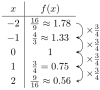
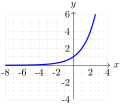
Consider the graph of \(f(x) = 2^x\text{.}\) First, create a table of values, using \(x\)-values of \(-2, -1, 0, 1\text{,}\) and 2, and plugging them into the equation.
Then, connect these points with a smooth curve. Here is a graph: Graph of \(f(x)=2^x\). Observe the \(y\)-values of \(0.25, 0.5, 1, 2, 4\text{.}\) Notice that each time \(x\) increases by 1, \(y\) is multiplied by 2.
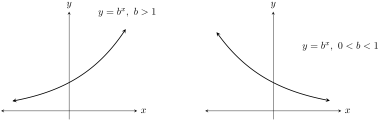
Here is a graph: Graph of \(f(x)=3^x\). Notice that it grows faster than \(2^x\text{,}\) because each time \(x\) increases by 1, \(y\) multiplies by 3 (instead of 2).
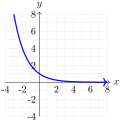
Here is a graph: Graph of \(f(x)=\brac{\frac{1}{2}}^x\). Here, each time \(x\) increases by 1, \(y\) is multiplied by \(\frac{1}{2}\text{,}\) which means it gets smaller.
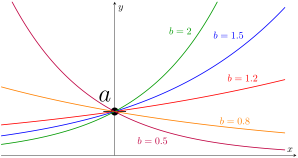
Here is a Desmos graph that allows you to graph \(f(x)=b^x\text{,}\) where you can use the slider to change the value of \(b\text{:}\)Exponential Functions.
The range is all positive numbers, or \(y \gt 0\text{,}\) because raising a number \(b\) to the exponent \(x\) always gives a positive output (even if \(x\) is negative).
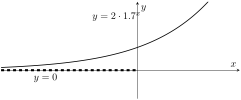
Also, notice that all of the functions “flatten out” around the \(x\)-axis. We call this a horizontal asymptote. So, the graph has a horizontal asymptote of the \(x\)-axis, or the line \(y=0\text{.}\)
Figure13.1.18.Exponential functions \(f(x)=a\cdot b^x\text{,}\) all with the same \(y\)-intercept \(a\text{,}\) but with different growth factors \(b\)
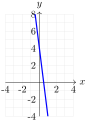
Sketch the graph of each exponential function, using its \(y\)-intercept and 1 more point. State the \(y\)-intercept, increasing/decreasing, domain, and range.
Trial-and-error: A basic method is to approximate the solution using trial and error. Choose an initial guess for the solution and plug it in, and see if it equals the other side. Then, adjust your solution up or down, depending on if your output is too high or low.
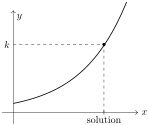
Graphically: Another method is to solve graphically (just like any other type of equation). Graph each side of the equation, and the solution is the point where they intersect. You can do this using Desmos, or a graphing calculator like the TI-84 Plus CE. In particular, the solution is the \(x\)-coordinate of the intersection point.
To solve \(3^x=7\) graphically, graph \(y=3^x\) and \(y=7\) on the same graph: Graph of \(y=3^x\) and \(y=7\). The intersection point is about \(x \approx 1.77\text{,}\) which is the answer.
Solving by scientific calculator. My recommended calculator can solve exponential equations numerically (just like any other equation). For details, see Solving Equations with a Scientific Calculator.