Skip to main content\(\newcommand{\N}{\mathbb N}
\newcommand{\Z}{\mathbb Z}
\newcommand{\Q}{\mathbb Q}
\newcommand{\R}{\mathbb R}
\newcommand{\abs}[1]{\left\lvert #1 \right\rvert}
\newcommand{\set}[1]{\left\{ #1 \right\}}
\renewcommand{\neg}{\sim}
\newcommand{\brac}[1]{\left( #1 \right)}
\newcommand{\rad}[1]{#1 \ \text{rad}}
\newcommand{\eval}[1]{\left. #1 \right|}
\newcommand{\floor}[1]{\left\lfloor #1 \right\rfloor}
\newcommand{\ceil}[1]{\left\lceil #1 \right\rceil}
\newcommand{\ang}[1]{#1^\circ}
\newcommand{\crossmethod}[4]{
\begin{tikzpicture}[baseline=(M.base)]
\node (M) at (0,0) {$#1$};
\node (P) at (0,-1) {$#2$};
\node (N) at (1.5,0) {$#3$};
\node (Q) at (1.5,-1) {$#4$};
\draw (M) -- (Q);
\draw (P) -- (N);
\end{tikzpicture}
}
\newcommand{\lt}{<}
\newcommand{\gt}{>}
\newcommand{\amp}{&}
\definecolor{fillinmathshade}{gray}{0.9}
\newcommand{\fillinmath}[1]{\mathchoice{\colorbox{fillinmathshade}{$\displaystyle \phantom{\,#1\,}$}}{\colorbox{fillinmathshade}{$\textstyle \phantom{\,#1\,}$}}{\colorbox{fillinmathshade}{$\scriptstyle \phantom{\,#1\,}$}}{\colorbox{fillinmathshade}{$\scriptscriptstyle\phantom{\,#1\,}$}}}
\)
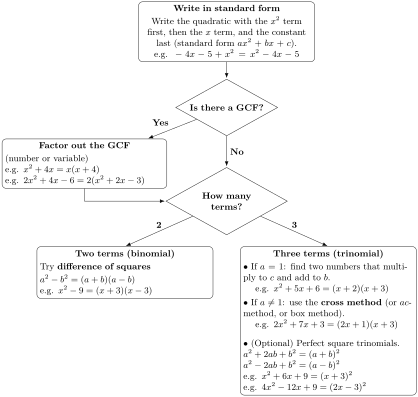
Section 4.5 Factoring Quadratics Summary
-
Write the quadratic in descending power order (standard form),
\(ax^2 + bx + c\text{.}\)
-
e.g.
\(-5 - 4x + x^2 = x^2 - 4x - 5\)
-
If there is a GCF (greatest common factor), factor it out (either a number or variable like
\(x\)).
-
e.g.
\(x^2 + 4x = x(x+4)\)
-
e.g.
\(2x^2 + 4x - 6 = 2(x^2 + 2x - 3)\)
-
Determine which factoring method applies, based on the form:
-
If
\(a = 1\text{,}\) find two numbers that multiply to
\(c\) and add to
\(b\text{.}\)
-
e.g.
\(x^2 + 5x + 6 = (x+2)(x+3)\)
-
If
\(a \neq 1\text{,}\) use the cross method (or
\(ac\)-method, or box method).
-
e.g.
\(2x^2 + 7x + 3 = (2x+1)(x+3)\)
-
If there are only 2 terms, try difference of squares.
\begin{gather*}
a^2 - b^2 = (a+b)(a-b) \qquad \text{e.g. } x^2 - 9 = (x+3)(x-3)
\end{gather*}
-
(Optional) use perfect square factoring patterns:
\begin{align*}
\begin{aligned}
a^2 + 2ab + b^2 \amp = (a+b)^2 \\
a^2 - 2ab + b^2 \amp = (a-b)^2
\end{aligned}
\qquad
\begin{aligned}
\text{e.g. } x^2+6x+9 \amp = (x+3)^2 \\
\text{e.g. } 4x^2 - 12x + 9 \amp = (2x-3)^2
\end{aligned}
\end{align*}
Subsection 4.5.1 Factoring Quadratics Flowchart