Section 14.1 Radian Measure

There is another unit for measuring angles, called a radian, which turns out to be more useful than degrees, particularly in calculus.

Definition 14.1.1.

Radians are a unit of angles such that,
\begin{gather*} \boxed{\pi \text{ radians} = 180^{\circ}} \qquad \text{or, equivalently,} \qquad \boxed{2\pi \text{ radians} = 360^{\circ}} \end{gather*}
In other words,
  • The symbol for radians is β€œrad”, however the symbol is often omitted. So, if an angle has no unit, it should be assumed to be radians (and for degrees, use \(^\circ\)).

Subsection 14.1.1 Converting Between Degrees and Radians

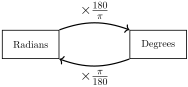
The equivalence \(\pi = 180^{\circ}\) can be thought of as a conversion factor, a ratio to convert between these two angle units (analogous to how 1 inch = 2.54 cm, or how 1 hour = 60 minutes).

Example 14.1.3. Converting Degrees to Radians.

Convert \(120^{\circ}\) to radians. To do this, multiply by \(\frac{\pi}{180}\text{,}\)
\begin{align*} 120^{\circ} \times \frac{\pi}{180}\\ \amp= \frac{120\pi}{180} \amp\amp \text{multiplying}\\ \amp= \frac{2\pi}{3} \amp\amp \text{simplifying} \end{align*}
So, \(120^{\circ} = \frac{2\pi}{3}\) radians.

Example 14.1.4. Converting Radians to Degrees.

Convert \(\frac{5\pi}{6}\) to degrees. To do this, multiply by \(\frac{180}{\pi}\text{,}\)
\begin{align*} \frac{5\pi}{6} \times \frac{180}{\pi}\\ \amp= \frac{5 \times 180}{6} \amp\amp \text{multiplying}\\ \amp= 150^{\circ} \amp\amp \text{simplifying} \end{align*}
So, \(\frac{5\pi}{6} = 150^{\circ}\text{.}\) Notice that the \(\pi\) cancels out, which is why we can just multiply the numerator by 180 and divide by the denominator to get the answer in degrees.
If you have a scientific calculator with ability to simplify fractions, you can use it to do these calculations more efficiently. For example,
  • To convert \(120^{\circ}\) to radians, you can enter \(120 \cdot \frac{\pi}{180}\) directly into your calculator, and it will give you the answer in radians, in simplified form.
  • To convert \(\frac{5\pi}{6}\) to degrees, you can enter \(\frac{5\pi}{6} \cdot \frac{180}{\pi}\) directly into your calculator, and it will give you the answer in degrees.

Exercise Group 14.1.1. Angle Conversion Practice.

Convert each angle from degrees to radians or radians to degrees.

Subsection 14.1.2 Sketching Angles in Radians

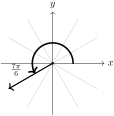
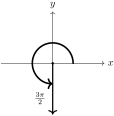
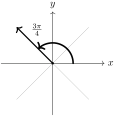
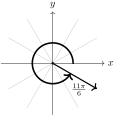
To graph an angle in radians, it’s easiest to think in terms of fractions of \(\pi\text{.}\) To start, recall that:
From this foundation, we can think about most other angles you’ll encounter. For example,
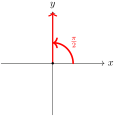
  • \(\frac{\pi}{2}\) (or half of \(\pi\)) is a quarter rotation (half of a half rotation). It’s equivalent to \(90^{\circ}\text{.}\)
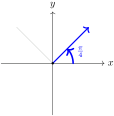
  • \(\frac{\pi}{4}\) (or a quarter of \(\pi\)) is half of a quarter rotation. This is equivalent to \(45^{\circ}\text{.}\)
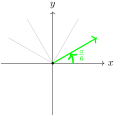
  • \(\frac{\pi}{6}\) is \(\pi\) split into 6 equal pieces, which is \(30^{\circ}\text{.}\)
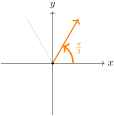
  • \(\frac{\pi}{3}\) is \(\pi\) split into 3 pieces, which is \(60^{\circ}\text{.}\)
For bigger angles, we can count multiples of those smaller angles \(\frac{\pi}{2}, \frac{\pi}{3}, \frac{\pi}{4}, \frac{\pi}{6}\text{.}\)

Example 14.1.5. Sketching 2pi/3.

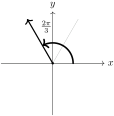
For \(\frac{2\pi}{3}\text{,}\) first divide \(\pi\) into 3 equal pieces, and then count 2 of them counterclockwise,

Example 14.1.6. Sketching 5pi/6.

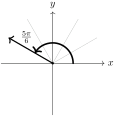
For \(\frac{5\pi}{6}\text{,}\) first divide \(\pi\) into 6 equal pieces, and then count 5 of them (counterclockwise),

Example 14.1.7. Sketching 7pi/4.

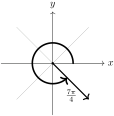
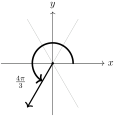
For \(\frac{7\pi}{4}\text{,}\) first divide \(\pi\) into 4 equal pieces, and then count 7 of them (counterclockwise),

Exercise Group 14.1.2. Sketching Practice.

Subsection 14.1.3 Motivating Radians

A very natural question is why we use radians. Here, we will step back, and explore the intuition behind radians, and how they come about to measure angles.

Example 14.1.8. Alternate Units for Angles.

First, it is helpful to step back and understand the idea of how angles can be measured.
Degrees are a unit of rotation defined such that 360 degrees make a full rotation. They are useful practical applications (historically, for navigation, architecture, and astronomy), because you can divide 360 evenly into many numbers (like 2, 3, 4, 5, 6, 8, 9, 10, 12, etc.), so many common angles have whole number values (like \(30^{\circ}, 45^{\circ}, 60^{\circ}, 90^{\circ}\text{,}\) etc.).
However, if we were starting from scratch, with no prior knowledge of degrees, we could consider other useful units of measuring angles. For example:
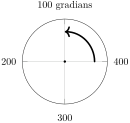
  • The gradian, where a quarter rotation is defined to be 100 gradians. Then, a full rotation would be 400 gradians.
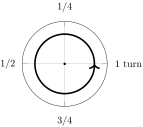
  • Or, 1 turn could be defined as a full rotation. Then, a half rotation is \(\frac{1}{2}\) turns, or a quarter rotation is \(\frac{1}{4}\) turns.
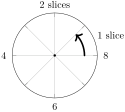
  • For units inspired by the fact that a pizza has 8 slices, a unit could be called a slice, defined to be \(\frac{1}{8}\)th of a full rotation. Then, 8 slices would be a full rotation.
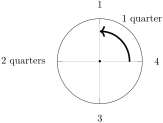
  • We could define 1 quarter to be a quarter rotation. Then, 4 quarters is a full rotation.
Ultimately, units are a convention, and what units are useful or most natural depends on the context.
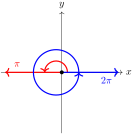
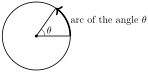
With radians, the idea is that we will measure angles based on how long the arc of the angle is.
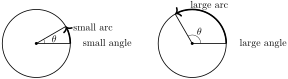
The longer the arc is, the bigger the angle that is swept out.
In other words, the amount of rotation (the angle) is proportional to how far you travel along the circle.
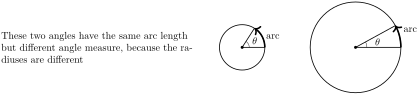
However, just measuring the arc doesn’t fully work, because the arc length depends on the size of the circle (basically, it depends on its radius).
  • If you have a small circle, you won’t have to go very far to make a full loop.
  • If you have a big circle, the same angle will mean you go a lot farther.
We want a measurement which purely measures rotation, that isn’t affected by how big the circle is. The key idea is: even though the arc length changes when the circle gets bigger or smaller, it changes in a very predictable way. In particular, arc length is proportional to the radius.

Example 14.1.9. Arc Length Proportionality.

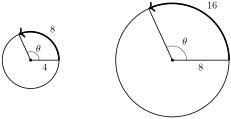
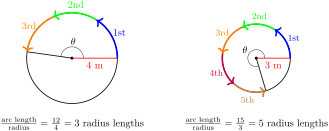
To measure arc length, instead of using meters or centimeters or any other unit of length, we use the radius itself as the unit. In other words, we ask:
\begin{equation*} \boxed{\text{"How many radius-lengths did you travel?"}} \end{equation*}
For example:
  • If the radius is 4 m, and the arc length is 12 m, that is \(\frac{12}{4} = 3\) radius lengths of rotation.
  • If the radius is 3 m, and the arc length is 15 m, that is \(\frac{15}{3} = 5\) radius lengths of rotation.
In other words, to measure the angle, divide the arc length by the radius length.

Subsection 14.1.4 Radians

In short, radians measure angles based on the arc length associated with the angle, in terms of radius lengths.

Definition 14.1.10.

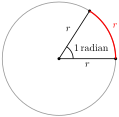
One radian is defined to be the angle at the center of a circle such that the arc length associated with it is equal to the radius \(r\) of the circle,
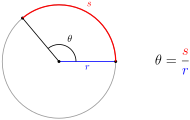
More generally, an angle \(\theta\) with associated radius \(r\) and arc length \(s\) is given by,
\begin{equation*} \boxed{\theta = \frac{s}{r}} \end{equation*}

Remark 14.1.11.

In fancy math language, we often say that the angle \(\theta\) subtends the arc, or the arc is subtended by the angle \(\theta\text{.}\) Basically, this means the angle \(\theta\) β€œgoes with” the arc.

Remark 14.1.12.

Radians are technically β€œdimensionless”, because they are the ratio of two lengths. Arc length has the same units as the radius, so radians are like \(\frac{\text{metres}}{\text{metres}}\text{,}\) so the units cancel out. So, radians are like a pure number.