Section 3.2 Cubes and Right Prisms

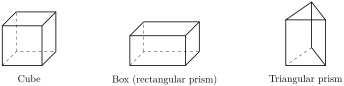
First, we’ll analyze shapes like cubes, boxes, and other β€œprisms”.
Notice that all of these shapes have 2 bases, that are connected by flat rectangular faces. This type of shape is called a right prism. The word β€œright” means the sides are perpendicular to the base (they are at right angles to the base).

Subsection 3.2.1 Cube

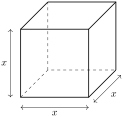
A cube is a right prism where all 6 faces are squares, which are all the same size. If the side length is \(x\text{,}\) then to get volume, multiply all 3 of the dimensions together.
This gives \(x \cdot x \cdot x\) = \(x^3\text{.}\)
The volume of a cube is,
\begin{equation*} \boxed{V_{\text{cube}} = x^3 \quad x \rightarrow \text{side length}} \end{equation*}

Checkpoint 3.2.1. Volume of a Cube.

Remark 3.2.2.

This is why raising a number to the third power is called β€œcubing” the number: it gives the volume of a cube with that side length.

Subsection 3.2.2 Rectangular Prism

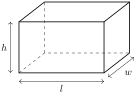
A rectangular prism has the shape of a box. Let’s say that the length is \(l\text{,}\) width is \(w\text{,}\) and height is \(h\text{.}\)
Then, the volume is found by multiplying all 3 dimensions together.
The volume of a rectangular prism is,
\begin{equation*} \boxed{V_{\text{rect. prism}} = l \cdot w \cdot h \quad \begin{cases} l \rightarrow \text{length} \\ w \rightarrow \text{width} \\ h \rightarrow \text{height} \end{cases}} \end{equation*}

Checkpoint 3.2.3. Volume of a Rectangular Prism.

Find the volume of a rectangular prism with length 6 cm, width 4 cm, and height 3 cm.
Answer.
\(V = (6)(4)(3) = 72 \text{ cm}^3\text{.}\)

Subsection 3.2.3 Volume of a General Right Prism

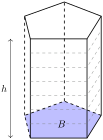
More generally, the volume of a prism is the area of its base multiplied by its height.
\begin{equation*} \boxed{V_{\text{prism}} = \text{(area of base)} \times \text{(height)}} \end{equation*}
Intuitively, a prism is a β€œstack” of identical cross-sections, so the volume is the area of one cross-section, multiplied by the height of the stack.
The volume of a right prism is,
\begin{equation*} \boxed{V_{\text{prism}} = Bh \quad \begin{cases} B \rightarrow \text{base area} \\ h \rightarrow \text{height} \end{cases}} \end{equation*}
This formula works for prisms with any base shape: triangular, pentagonal, hexagonal, etc. Simply compute the area of the base and multiply by the height.

Example 3.2.4. Volume of a Triangular Prism.

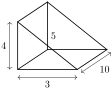
Find the volume of a triangular prism whose base is a right triangle with legs 3 cm and 4 cm, and whose height is 10 cm.
Answer: The base is a right triangle with area \(B = \frac{1}{2}(3)(4) = 6 \text{ cm}^2\text{.}\) So,
\begin{equation*} V = Bh = (6)(10) = 60 \text{ cm}^3. \end{equation*}

Subsection 3.2.4 Surface Area of a Cube and Other Prisms

The surface area of a prism is found by adding the areas of all of its faces.
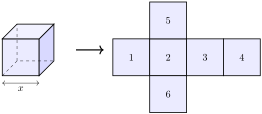
A cube has 6 square faces which are all the same size. To see this, imagine cutting the cube along its edges and unfolding it flat. The result is called a net,
Each of the 6 faces is a square with area \(x^2\text{.}\) So,
The surface area of a cube is,
\begin{equation*} \boxed{SA_{\text{cube}} = 6x^2 \quad x \rightarrow \text{side length}} \end{equation*}

Example 3.2.5. Volume and Surface Area of a Cube.

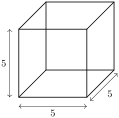
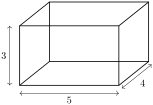
Find the volume and surface area of a cube with side length 5 cm.
The volume is,
\begin{align*} V \amp= x^3\\ \amp= 5^3\\ \amp= 125 \text{ cm}^3 \end{align*}
The surface area is,
\begin{align*} SA \amp= 6x^2\\ \amp= 6(5)^2\\ \amp= 6(25)\\ \amp= 150 \text{ cm}^2 \end{align*}
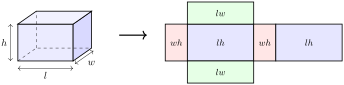
For a rectangular prism, it also has 6 faces, which are 3 pairs of rectangles. Unfolding it into a net, we can see all 6 faces,
Then, 2 faces have area \(lw\text{,}\) 2 have area \(lh\text{,}\) and 2 have area \(wh\text{.}\) Adding all of these up gives the total surface area.
The surface area of a rectangular prism is,
\begin{equation*} \boxed{SA_{\text{rect.\ prism}} = 2lw + 2lh + 2wh \quad \begin{cases} l \rightarrow \text{length} \\ w \rightarrow \text{width} \\ h \rightarrow \text{height} \end{cases}} \end{equation*}

Example 3.2.6. Rectangular Prism.

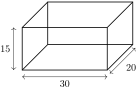
A shipping box is 30 cm long, 20 cm wide, and 15 cm tall. Find its volume and surface area.
The volume is,
\begin{align*} V \amp= lwh\\ \amp= (30)(20)(15)\\ \amp= 9000 \text{ cm}^3 \end{align*}
The surface area is,
\begin{align*} SA \amp= 2lw + 2lh + 2wh\\ \amp= 2(30)(20) + 2(30)(15) + 2(20)(15)\\ \amp= 1200 + 900 + 600\\ \amp= 2700 \text{ cm}^2 \end{align*}
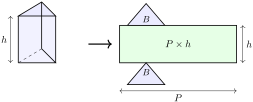
For a general right prism, imagine unfolding the shape.
The two bases each have area \(B\text{.}\) The lateral (side) surface, when unrolled flat, forms a rectangle whose width is the perimeter \(P\) of the base and whose height is \(h\text{,}\) so the area of the lateral surface is \(Ph\text{.}\) Adding these together gives the total surface area.
The surface area of a right prism is,
\begin{equation*} \boxed{SA_{\text{prism}} = 2B + Ph \quad \begin{cases} B \rightarrow \text{base area} \\ P \rightarrow \text{base perimeter} \\ h \rightarrow \text{height} \end{cases}} \end{equation*}

Example 3.2.7. Triangular Prism.

A right prism has a triangular base with legs 3 cm and 4 cm (a right triangle), and the prism has height 10 cm. Find its volume and surface area.
First, find the base area. The base is a right triangle with legs 3 and 4, so,
\begin{equation*} B = \frac{1}{2}(3)(4) = 6 \text{ cm}^2 \end{equation*}
The volume is,
\begin{equation*} V = Bh = 6 \times 10 = 60 \text{ cm}^3 \end{equation*}
For the surface area, we need the perimeter of the base. By the Pythagorean theorem, the hypotenuse of the triangle is,
\begin{equation*} c = \sqrt{3^2 + 4^2} = \sqrt{9 + 16} = \sqrt{25} = 5 \text{ cm} \end{equation*}
So the perimeter is \(P = 3 + 4 + 5 = 12\) cm. Then,
\begin{align*} SA \amp= 2B + Ph\\ \amp= 2(6) + 12(10)\\ \amp= 12 + 120\\ \amp= 132 \text{ cm}^2 \end{align*}

Subsection 3.2.5 Examples

Exercise Group 3.2.1. Volume and Surface Area of Prisms.

Find the volume and surface area of each prism.
(b)
A rectangular prism with length 12 cm, width 8 cm, and height 5 cm.
Answer.
\(V = 480 \text{ cm}^3\text{,}\) \(SA = 392 \text{ cm}^2\text{.}\)
(c)
A rectangular prism with dimensions \(2.5 \text{ m} \times 3.2 \text{ m} \times 4.0 \text{ m}\text{.}\)
Answer.
\(V = 32 \text{ m}^3\text{,}\) \(SA = 62.8 \text{ m}^2\text{.}\)
(d)
A right prism with a triangular base. The base is an equilateral triangle with side length 6 cm, and the prism has height 14 cm.
Hint.
The area of an equilateral triangle with side \(a\) is \(\frac{\sqrt{3}}{4}a^2\text{.}\)
Answer.
\(V = 9\sqrt{3} \times 14 = 126\sqrt{3} \approx 218.2 \text{ cm}^3\text{,}\) \(SA = 18\sqrt{3} + 252 \approx 283.2 \text{ cm}^2\text{.}\)

Exercise Group 3.2.2. Reverse Problems.

Solve each problem.
(a)
A cube has surface area \(294 \text{ cm}^2\text{.}\) Find its side length and volume.
Hint.
\(SA = 6x^2\text{,}\) solve for \(x\text{.}\)
Answer.
\(x^2 = 49\text{,}\) so \(x = 7\) cm. \(V = 343 \text{ cm}^3\text{.}\)
(b)
A rectangular prism has volume \(1200 \text{ cm}^3\text{,}\) length 15 cm, and width 10 cm. Find its height.
Answer.
\(h = \frac{1200}{15 \times 10} = 8\) cm.
(c)
A cube has volume \(1000 \text{ cm}^3\text{.}\) Find its side length to the nearest tenth.
Answer.
\(x = \sqrt[3]{1000} = 10\) cm.

Exercise Group 3.2.3. Unit Conversions.

Solve each problem.
(a)
A rectangular fish tank is 60 cm long, 30 cm wide, and 40 cm tall. Find the volume of the tank in \(\text{cm}^3\text{,}\) then convert to litres.
Answer.
\(V = 60 \times 30 \times 40 = 72{,}000 \text{ cm}^3 = 72 \text{ L}\text{.}\)
(b)
A rectangular container is \(1.2 \text{ m} \times 0.8 \text{ m} \times 0.5 \text{ m}\text{.}\) How many litres of water can it hold?
Answer.
\(V = 1.2 \times 0.8 \times 0.5 = 0.48 \text{ m}^3 = 480 \text{ L}\text{.}\)

Example 3.2.8. Cube: Reverse Problem.

A cube has volume \(64 \text{ cm}^3\text{.}\) Find its side length and surface area.
Since \(V = x^3\text{,}\) we have,
\begin{align*} x^3 \amp= 64\\ x \amp= \sqrt[3]{64}\\ x \amp= 4 \text{ cm} \end{align*}
Then, the surface area is,
\begin{equation*} SA = 6x^2 = 6(4)^2 = 6(16) = 96 \text{ cm}^2 \end{equation*}

Checkpoint 3.2.9. Hexagonal Prism.

A right prism has a regular hexagonal base with side length 4 cm and height 12 cm. Find its volume.
Hint.
A regular hexagon with side length \(a\) has area \(\frac{3\sqrt{3}}{2}a^2\text{.}\)
Answer.
\(B = \frac{3\sqrt{3}}{2}(4)^2 = 24\sqrt{3}\text{.}\) \(V = 24\sqrt{3} \times 12 = 288\sqrt{3} \approx 498.8 \text{ cm}^3\text{.}\)

Checkpoint 3.2.10. Finding Height from Surface Area.

A closed box has a surface area of \(126 \text{ in}^2\text{.}\) The base of the box is 5 in by 3 in. Sketch a diagram and find the height of the box.
Hint.
Set up the SA formula and solve for \(h\text{.}\)
Answer.
\(126 = 2(15) + 2(5h) + 2(3h) = 30 + 10h + 6h = 30 + 16h\text{.}\) So \(16h = 96\text{,}\) giving \(h = 6\) in.

Checkpoint 3.2.11. Finding Width from Surface Area.

A rectangular prism has SA \(= 6020 \text{ cm}^2\) and dimensions \(34 \text{ cm} \times 20 \text{ cm} \times w\text{.}\) Find \(w\text{.}\)
Answer.
\(6020 = 2(680) + 2(34w) + 2(20w) = 1360 + 68w + 40w = 1360 + 108w\text{.}\) So \(108w = 4660\text{,}\) giving \(w \approx 43.1\) cm.

Checkpoint 3.2.12. Cube with Same Volume.

A rectangular prism has dimensions \(9 \text{ in} \times 4 \text{ in} \times 6 \text{ in}\text{.}\) A cube is to be made with the same volume. What is the side length of the cube?
Answer.
\(V = 9 \times 4 \times 6 = 216 \text{ in}^3\text{.}\) \(x^3 = 216\text{,}\) so \(x = 6\) in.

Subsection 3.2.6 Word Problems

Example 3.2.13. Painting a Room.

A room is 5 m long, 4 m wide, and 3 m tall. How many litres of paint are needed if 1 litre covers \(10 \text{ m}^2\text{?}\) Assume you paint the four walls and the ceiling, but not the floor.
First, compute the area to be painted. The four walls have a combined area equal to the perimeter of the floor times the height,
\begin{align*} A_{\text{walls}} \amp= P \times h\\ \amp= 2(5 + 4) \times 3\\ \amp= 2(9)(3)\\ \amp= 54 \text{ m}^2 \end{align*}
The ceiling has area,
\begin{equation*} A_{\text{ceiling}} = 5 \times 4 = 20 \text{ m}^2 \end{equation*}
The total area to paint is,
\begin{equation*} A_{\text{total}} = 54 + 20 = 74 \text{ m}^2 \end{equation*}
Then, the number of litres needed is,
\begin{equation*} \text{litres} = \frac{74}{10} = 7.4 \text{ L} \end{equation*}
So you would need to buy at least 8 litres of paint.

Checkpoint 3.2.14. Wrapping Paper.

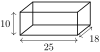
A gift box is 25 cm long, 18 cm wide, and 10 cm tall. How much wrapping paper is needed to cover the box (ignoring overlap)?
Answer.
\(SA = 2(25)(18) + 2(25)(10) + 2(18)(10) = 900 + 500 + 360 = 1760 \text{ cm}^2\text{.}\)

Checkpoint 3.2.15. Storage Unit.

A storage unit is 3 m long, 2.5 m wide, and 2.4 m tall. How many cubic metres of storage space does it have? How many boxes measuring \(0.5 \text{ m} \times 0.5 \text{ m} \times 0.5 \text{ m}\) can fit inside (assuming perfect packing)?
Answer.
\(V_{\text{unit}} = 3 \times 2.5 \times 2.4 = 18 \text{ m}^3\text{.}\) Each box has \(V = 0.125 \text{ m}^3\text{.}\) Along length: \(3/0.5 = 6\text{.}\) Along width: \(2.5/0.5 = 5\text{.}\) Along height: \(2.4/0.5 = 4\) (with 0.4 m unused). So \(6 \times 5 \times 4 = 120\) boxes.

Checkpoint 3.2.16. Aquarium.

An aquarium is 80 cm long, 40 cm wide, and 50 cm tall. It is filled with water to a height of 45 cm. How many litres of water are in the aquarium?
Answer.
\(V = 80 \times 40 \times 45 = 144{,}000 \text{ cm}^3 = 144 \text{ L}\text{.}\)

Checkpoint 3.2.17. Comparing Lockers.

At a recreation centre, you choose between two types of lockers. A single locker from a double stack measures 0.4 m wide by 0.6 m deep, and the full stack is 1.8 m tall. A single locker from a triple stack measures 30 in wide by 15 in deep, and the full stack is 41 in tall. Which type of locker gives you more space, and how much more (in cubic metres)?
Hint.
Find the height of one locker in each stack, then convert all dimensions to metres (\(1 \text{ in} \approx 2.54 \text{ cm}\)).
Answer.
Double-stack locker: \(0.9 \times 0.4 \times 0.6 = 0.216 \text{ m}^3\text{.}\) Triple-stack: height \(= \frac{41}{3} \approx 13.67\) in, so dimensions \(\approx 76.2 \times 38.1 \times 34.7\) cm. Volume \(\approx 0.101 \text{ m}^3\text{.}\) The double-stack gives about \(0.12 \text{ m}^3\) more space.

Checkpoint 3.2.18. Storage Cabinet.

A wooden storage cabinet is a right rectangular prism, 6 ft tall, 3 ft wide, and 30 in deep. Calculate the volume of the cabinet. Then, if the height is reduced by one quarter (keeping width and depth the same), what is the new volume? How does reducing one dimension by a factor of \(k\) affect the volume?
Answer.
Depth \(= 30 \text{ in} = 2.5\) ft. \(V = 6 \times 3 \times 2.5 = 45 \text{ ft}^3\text{.}\) New height \(= 6 \times \frac{3}{4} = 4.5\) ft. New \(V = 4.5 \times 3 \times 2.5 = 33.75 \text{ ft}^3\text{.}\) The new volume is \(\frac{3}{4}\) of the original. In general, multiplying one dimension by \(k\) multiplies the volume by \(k\text{.}\)

Checkpoint 3.2.19. Dogsled Kennels.

For a dogsled race, a competitor builds a trailer that is a right rectangular prism measuring 2 m wide, 1.6 m high, and 3.2 m long. The trailer is divided into 16 identical kennels (in 2 rows of 8). How much material is needed to build the kennels?
Hint.
Account for the outer walls and the interior dividing walls.
Answer.
Outer shell: \(SA = 2(3.2)(2) + 2(3.2)(1.6) + 2(2)(1.6) = 12.8 + 10.24 + 6.4 = 29.44 \text{ m}^2\text{.}\) Interior: one lengthwise divider \(= 3.2 \times 1.6 = 5.12 \text{ m}^2\text{,}\) seven crosswise dividers \(= 7(2 \times 1.6) = 22.4 \text{ m}^2\text{.}\) Total \(\approx 56.96 \text{ m}^2\text{.}\)

Checkpoint 3.2.20. Maximum Volume from Material.

You have \(500 \text{ cm}^2\) of material. What is the maximum volume of a cube you can make with this material?
Hint.
The SA of a cube is \(6x^2\text{,}\) solve for \(x\text{.}\)
Answer.
\(6x^2 = 500\text{,}\) so \(x = \sqrt{\frac{500}{6}} \approx 9.13\) cm. \(V = x^3 \approx 760.7 \text{ cm}^3\text{.}\)