Skip to main content
Contents Dark Mode Prev Up Next \(\newcommand{\N}{\mathbb N}
\newcommand{\Z}{\mathbb Z}
\newcommand{\Q}{\mathbb Q}
\newcommand{\R}{\mathbb R}
\newcommand{\abs}[1]{\left\lvert #1 \right\rvert}
\newcommand{\set}[1]{\left\{ #1 \right\}}
\renewcommand{\neg}{\sim}
\newcommand{\brac}[1]{\left( #1 \right)}
\newcommand{\rad}[1]{#1 \ \text{rad}}
\newcommand{\eval}[1]{\left. #1 \right|}
\newcommand{\floor}[1]{\left\lfloor #1 \right\rfloor}
\newcommand{\ceil}[1]{\left\lceil #1 \right\rceil}
\newcommand{\ang}[1]{#1^\circ}
\newcommand{\crossmethod}[4]{
\begin{tikzpicture}[baseline=(M.base)]
\node (M) at (0,0) {$#1$};
\node (P) at (0,-1) {$#2$};
\node (N) at (1.5,0) {$#3$};
\node (Q) at (1.5,-1) {$#4$};
\draw (M) -- (Q);
\draw (P) -- (N);
\end{tikzpicture}
}
\newcommand{\lt}{<}
\newcommand{\gt}{>}
\newcommand{\amp}{&}
\definecolor{fillinmathshade}{gray}{0.9}
\newcommand{\fillinmath}[1]{\mathchoice{\colorbox{fillinmathshade}{$\displaystyle \phantom{\,#1\,}$}}{\colorbox{fillinmathshade}{$\textstyle \phantom{\,#1\,}$}}{\colorbox{fillinmathshade}{$\scriptstyle \phantom{\,#1\,}$}}{\colorbox{fillinmathshade}{$\scriptscriptstyle\phantom{\,#1\,}$}}}
\)
Section 3.1 Volume and Surface Area
For every 3-dimensional shape, we want to answer two fundamental questions:
How much space does it take up?
How much surface does it have?
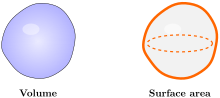
These are the ideas of volume and surface area.
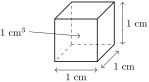
Volume is the amount of space a 3-dimensional object occupies. It is measured in cubic units, such as
\(\text{cm}^3\) or
\(\text{m}^3\text{.}\)
Surface area is the total area of the boundary of a 3-dimensional object. It is measured in square units, such as
\(\text{cm}^2\) or
\(\text{m}^2\text{.}\)
Volume tells you how much water a container can hold.
Surface area tells you how much paint you need to cover it.
Remark 3.1.1 . Units.
We will analyze the volume and surface area of a bunch of different 3-dimensional shapes. These shapes fall into 2 families, plus 1 special shape.
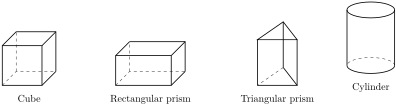
The
prism family includes shapes with 2 identical bases connected by flat (or curved) sides:
Cubes and rectangular prisms
More general prisms (e.g. with a triangular base)
Cylinders (a prism with a circular base)
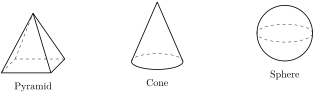
The
pyramid family consists of shapes that meet up at a point at the top:
Cones (a pyramid with a circular base)
The
sphere stands on its own, as it has no base and no edges.