\begin{align*}
x^2 - 5x + 6 \amp= 0\\
(x - 2)(x - 3) \amp= 0\\
x - 2 = 0 \qquad x - 3 \amp= 0\\
x = 2 \qquad x \amp= 3
\end{align*}
Section 4.11 Summary of Quadratics
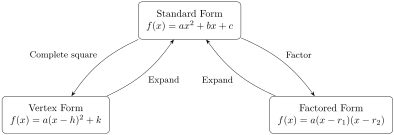
Subsection 4.11.1 Forms of a Quadratic Function
| Form | Name | Why it’s useful |
|---|---|---|
\(f(x) = ax^2 + bx + c\)
|
Standard form (general form)
|
|
\(f(x) = a(x - h)^2 + k\)
|
Vertex form
|
|
\(f(x) = a(x - r_1)(x - r_2)\)
|
Factored form (intercept form)
|
Subsection 4.11.2 Solving Quadratic Equations
There are many techniques used to solve quadratic equations. Some apply more broadly and some only to specific cases.
In short,
-
Move all terms to one side, so the other side is 0 (convert to standard form).
-
Use either (a) factoring, or (b) the quadratic formula.
Factoring. If \(ax^2 + bx + c\) can be factored easily, then factor and use the zero-product property to split it into two equations, and solve.
Example 4.11.2. Solving by Factoring.
Example 4.11.3. Solving by Factoring (with \(a \neq 1\)).
\begin{align*}
2x^2 + x - 3 \amp= 0\\
(2x+3)(x-1) \amp= 0\\
2x+3 = 0 \qquad x-1 \amp= 0\\
x = -\frac{3}{2} \qquad x \amp= 1
\end{align*}
Quadratic formula. If \(ax^2 + bx + c\) cannot be factored, or factoring is difficult, then use the quadratic formula,
\begin{equation*}
\boxed{x = \frac{-b \pm \sqrt{b^2 - 4ac}}{2a}}
\end{equation*}
Example 4.11.4. Using the Quadratic Formula.
\begin{align*}
2x^2 - 4x - 3 \amp= 0\\
x \amp= \frac{-(-4) \pm \sqrt{(-4)^2 - 4(2)(-3)}}{2(2)}\\
\amp= \frac{4 \pm \sqrt{40}}{4}\\
\amp= \frac{4 \pm 2 \sqrt{10}}{4} \amp\amp\text{simplifying the radical}\\
x \amp= \frac{2 \pm \sqrt{10}}{2} \amp\amp\text{cancelling a common factor of 2}
\end{align*}
Example 4.11.5. Using the Quadratic Formula.
\begin{align*}
3x^2 + 7x - 2 \amp= 0\\
x \amp= \frac{-7 \pm \sqrt{7^2 - 4(3)(-2)}}{2(3)}\\
\amp= \frac{-7 \pm \sqrt{49+24}}{6}\\
\amp= \frac{-7 \pm \sqrt{73}}{6}
\end{align*}
To find if it is factorable, check if the discriminant \(b^2 - 4ac\) is a perfect square.
-
If it is a perfect square (like 1, 4, 9, 16, 25, 36, \(\dots\)), it is factorable.
-
If not, it’s not factorable.
Special cases:
Missing \(x\) term. If there is no \(x\) term, then isolate \(x^2\text{,}\) and take the square root of both sides (don’t forget \(\pm\)).
\begin{align*}
3x^2 - 12 \amp= 0\\
3x^2 \amp= 12\\
x^2 \amp= 4\\
x \amp= \pm 2
\end{align*}
Vertex form. Slightly more generally, if it is in vertex form \((x - h)^2 + k = 0\text{,}\) then take the square root of both sides, and solve for \(x\text{.}\)
\begin{align*}
(x - 3)^2 - 7 \amp= 0\\
(x - 3)^2 \amp= 7\\
x - 3 \amp= \pm \sqrt{7}\\
x \amp= 3 \pm \sqrt{7}
\end{align*}
In this case, you could also expand the brackets, and try to use factoring or the quadratic formula, but this method uses fewer steps.
Missing constant term. If there is no constant term, \(ax^2 + bx = 0\text{,}\) then factor out the common factor of \(x\text{,}\) and set each equal to 0.
Example 4.11.6. Missing Constant Term.
\begin{align*}
2x^2 + 4x \amp= 0\\
2x(x + 2) \amp= 0\\
x = 0 \qquad x + 2 \amp= 0\\
x = 0 \qquad x \amp= -2
\end{align*}
Some notes:
-
Always look for common factors that you can divide out, especially if the numbers are big!
-
The quadratic formula always works, in that it can be used in all cases. However, it is sometimes overkill, applying a complicated formula to a simple situation unnecessarily, where a simpler technique would have worked.
-
Here is a classic math rap song: Do the Quad Solve, which is a parody of Do the John Wall by Troop 41.
-
Quadratic Formula Rap by Mr. 2Pi.

