Consider these powers of 10,
\begin{align*}
10^1 \amp = 10\\
10^2 \amp = 100\\
10^3 \amp = 1000\\
10^4 \amp = 10000
\end{align*}
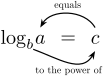
These tell you that 10 to an exponent gives a number. Now reverse the question. Instead of asking what \(10^3\) equals, ask: 10 to what power equals 1000? Since \(10^3=1000\text{,}\) the answer is 3.
Logarithms are a shorthand for this reverse question. The expression \(\log_{10}(x)\) (read this as “log base 10 of \(x\)”) means the exponent you put on 10 to get \(x\text{.}\) Intuitively, \(\log_{10}{x}\) is the number of 10s you need to multiply together in order to get \(x\text{.}\) So, for example,
\begin{align*}
\begin{array}{lcl} \amp \text{means...} \amp \\ 10^3=1000 \amp \longrightarrow \amp \log_{10}(1000)=3 \\ 10^5=100000 \amp \longrightarrow \amp \log_{10}(100000)=5 \\ 10^0=1 \amp \longrightarrow \amp \log_{10}(1)=0 \end{array}
\end{align*}
In other words,
-
Powers convert exponents to numbers
-
Logs convert numbers to exponent.
In this way, logarithms are a kind of inverse of exponents.