
Section 15.3 Sum and Difference Identities

The sum identities say that if you know about two angles \(\alpha\) and \(\beta\text{,}\) you can also find sine (or cosine, or tangent) of the two angles added together \(\alpha + \beta\text{.}\) The difference identities do the same for the difference (subtraction) \(\alpha - \beta\text{.}\)
\begin{align*} \boxed{ \begin{aligned} \sin{(\alpha + \beta)} & = \sin{\alpha}\cos{\beta} + \cos{\alpha}\sin{\beta} \\ \sin{(\alpha - \beta)} & = \sin{\alpha}\cos{\beta} - \cos{\alpha}\sin{\beta} \\ \cos{(\alpha + \beta)} & = \cos{\alpha}\cos{\beta} - \sin{\alpha}\sin{\beta} \\ \cos{(\alpha - \beta)} & = \cos{\alpha}\cos{\beta} + \sin{\alpha}\sin{\beta} \\ \tan{(\alpha + \beta)} & = \frac{\tan{\alpha} + \tan{\beta}}{1 - \tan{\alpha}\tan{\beta}} \\ \tan{(\alpha - \beta)} & = \frac{\tan{\alpha} - \tan{\beta}}{1 + \tan{\alpha}\tan{\beta}} \end{aligned} } \end{align*}
These identities are maybe the most challenging to remember at first, so definitely keep them available when practicing.
The 6 identities can be written more concisely as,
\begin{gather*} \boxed{\begin{array}{l} \sin{(\alpha \pm \beta)} = \sin{\alpha} \cos{\beta} \pm \cos{\alpha} \sin{\beta} \\[6pt] \cos{(\alpha \pm \beta)} = \cos{\alpha} \cos{\beta} \mp \sin{\alpha} \sin{\beta} \\[4pt] \tan{(\alpha \pm \beta)} = \dfrac{\tan{\alpha} \pm \tan{\beta}}{1 \mp \tan{\alpha} \tan{\beta}} \end{array}} \end{gather*}
Notice that for cosine and tangent, the left has \(\pm\) while the right has a \(\mp\) sign, which means that \(+\) on the left goes with \(-\) on the right, and \(-\) on the left goes with \(+\) on the right.

Subsection 15.3.1 Finding Exact Values Examples

The sum and difference identities can be used to find trigonometric ratios (like sine, cosine, and tangent) for several angles not typically found on the unit circle (i.e. not just \(0, \pi/6, \pi/4, \pi/3, \pi/2\) and their multiples).

Example 15.3.1. Find Cosine of \(\ang{105}\).

Find \(\cos{\ang{105}}\text{.}\) We can calculate this, because \(\ang{105} = \ang{60} + \ang{45}\) is the sum of two special angles (which we know about). Then, the sum identity for cosine says,
\begin{align*} \cos{\ang{105}} \amp = \cos{(\ang{60} + \ang{45})}\\ \amp = \cos{\ang{60}}\cos{\ang{45}} - \sin{\ang{60}}\sin{\ang{45}}\\ \amp = \frac{1}{2} \cdot \frac{\sqrt{2}}{2} - \frac{\sqrt{3}}{2} \cdot \frac{\sqrt{2}}{2} \end{align*}
This answer is correct, however we can continue to simplify the result into one fraction,
\begin{align*} \amp = \frac{\sqrt{2}}{4} - \frac{\sqrt{6}}{4}\\ \amp = \frac{\sqrt{2} - \sqrt{6}}{4} \end{align*}
Therefore, \(\cos{\ang{105}} = \frac{\sqrt{2} - \sqrt{6}}{4}\text{.}\)
Example 15.3.2. Find Tangent of \(\frac{5\pi}{12}\).

Find \(\tan{\brac{\frac{5\pi}{12}}}\text{.}\) Here, after some trial and error, \(\frac{5\pi}{12} = \frac{\pi}{4} + \frac{\pi}{6}\text{.}\) Then,
\begin{align*} \tan{\brac{\frac{5\pi}{12}}} \amp = \tan{\brac{\frac{\pi}{4} + \frac{\pi}{6}}}\\ \amp = \frac{\tan{\frac{\pi}{4}} + \tan{\frac{\pi}{6}}}{1 - \tan{\frac{\pi}{4}}\tan{\frac{\pi}{6}}}\\ \amp = \frac{1 + \frac{\sqrt{3}}{3}}{1 - 1 \cdot \frac{\sqrt{3}}{3}}\\ \amp = \frac{1 + \frac{\sqrt{3}}{3}}{1 - \frac{\sqrt{3}}{3}} \end{align*}
This answer is correct, however we can continue to simplify the result,
\begin{align*} \amp = \frac{3 + \sqrt{3}}{3 - \sqrt{3}} \amp\amp \text{multiplying numerator and denominator by 3} \end{align*}
This is a solid final answer. However, some instructors will expect that you rationalize the denominator to fully simplify,
\begin{align*} \amp = \frac{3 + \sqrt{3}}{3 - \sqrt{3}} \cdot \frac{3 + \sqrt{3}}{3 + \sqrt{3}} \amp\amp \text{multiplying numerator and denominator by $3 + \sqrt{3}$}\\ \amp = \frac{3 + 2\sqrt{3} + 1}{2}\\ \amp = \frac{4 + 2\sqrt{3}}{2}\\ \amp = 2 + \sqrt{3} \end{align*}
Therefore, \(\tan{\brac{\frac{5\pi}{12}}} = 2 + \sqrt{3}\text{.}\)
This works for any angle which can be written as the sum of two special angles (or the difference of two special angles). Here are some of the common ones.
  • \(\displaystyle \ang{15} = \ang{45} - \ang{30} = \ang{60} - \ang{45}\)
  • \(\displaystyle \ang{75} = \ang{45} + \ang{30}\)
  • \(\displaystyle \ang{105} = \ang{60} + \ang{45}\)
  • \(\displaystyle \ang{165} = \ang{120} + \ang{45}\)
Notice that there is often more than one way to write it (but maybe there is one easier way). For example, \(\ang{105} = \ang{60} + \ang{45}\text{,}\) but also \(\ang{105} = \ang{150} - \ang{45}\text{.}\) Also, in radians,
  • \(\displaystyle \frac{\pi}{12} = \frac{\pi}{4} - \frac{\pi}{6} = \frac{\pi}{3} - \frac{\pi}{4}\)
  • \(\displaystyle \frac{5\pi}{12} = \frac{\pi}{4} + \frac{\pi}{6}\)
  • \(\displaystyle \frac{7\pi}{12} = \frac{\pi}{3} + \frac{\pi}{4}\)
  • \(\displaystyle \frac{11\pi}{12} = \frac{2\pi}{3} + \frac{\pi}{4}\)

Exercise Group 15.3.1. Evaluate Exact Trigonometric Ratios.

Evaluate each trigonometric ratio exactly, and simplify your answer.
(a)
\(\sin{\ang{15}}\)
Answer.
\(\frac{\sqrt{6} - \sqrt{2}}{4}\)
(b)
\(\cos{\brac{\frac{5\pi}{12}}}\)
Answer.
\(\frac{\sqrt{6} - \sqrt{2}}{4}\)
(c)
\(\tan{\ang{105}}\)
Answer.
\(\frac{\sqrt{3}+1}{1-\sqrt{3}}\) (or rationalized \(-2 - \sqrt{3}\))
(d)
\(\sin 105^\circ\)
Answer.
\(\frac{\sqrt{6} + \sqrt{2}}{4}\)
(e)
\(\sin{\brac{\frac{7\pi}{12}}}\)
Answer.
\(\frac{\sqrt{6} + \sqrt{2}}{4}\)
(f)
\(\tan{\ang{15}}\)
Answer.
\(\frac{3-\sqrt{3}}{3+\sqrt{3}}\) (or rationalized, \(2 - \sqrt{3}\))
(g)
\(\cos{\ang{285}}\)
Hint.
\(\ang{285} = \ang{240} + \ang{45}\) is one combination.
Answer.
\(\frac{\sqrt{6} - \sqrt{2}}{4}\)
(h)
\(\sin{\frac{23\pi}{12}}\)
Hint.
\(\frac{23\pi}{12} = \frac{5\pi}{3} + \frac{\pi}{4}\) is one combination.
Answer.
\(\frac{\sqrt{2} - \sqrt{6}}{4}\)
(i)
\(\tan{\brac{-\frac{5\pi}{12}}}\)
Hint.
\(-\frac{5\pi}{12} = -\frac{\pi}{4} - \frac{\pi}{6}\) is one combination.
Answer.
\(\frac{-\sqrt{3}-3}{3-\sqrt{3}}\) or \(-2-\sqrt{3}\)
(j)
\(\cot{\brac{\frac{11\pi}{12}}}\)
(k)
\(\sec{\brac{\frac{19\pi}{12}}}\)

Remark 15.3.3.

In fact, there are only a relatively limited number of questions of this type that your teacher can give you. Here are pretty much all of them summarized in a table (between \(\ang{0}\) and \(\ang{360}\)),
\begin{align*} \begin{array}{c|c|c|c|c} \text{Angle (degrees)} & \text{Angle (radians)} & \text{Sine} & \text{Cosine} & \text{Tangent} \\ \hline \ang{15} & \frac{\pi}{12} & \frac{\sqrt{6} - \sqrt{2}}{4} & \frac{\sqrt{6} + \sqrt{2}}{4} & 2 - \sqrt{3} \\[4pt] \ang{75} & \frac{5\pi}{12} & \frac{\sqrt{6} + \sqrt{2}}{4} & \frac{\sqrt{6} - \sqrt{2}}{4} & 2 + \sqrt{3} \\[4pt] \ang{105} & \frac{7\pi}{12} & \frac{\sqrt{6} + \sqrt{2}}{4} & \frac{-\sqrt{6} + \sqrt{2}}{4} & -2 - \sqrt{3} \\[4pt] \ang{165} & \frac{11\pi}{12} & \frac{\sqrt{6} - \sqrt{2}}{4} & \frac{-\sqrt{6} - \sqrt{2}}{4} & -2 + \sqrt{3} \\[4pt] \ang{195} & \frac{13\pi}{12} & \frac{-\sqrt{6} + \sqrt{2}}{4} & \frac{-\sqrt{6} - \sqrt{2}}{4} & 2 - \sqrt{3} \\[4pt] \ang{255} & \frac{17\pi}{12} & \frac{-\sqrt{6} - \sqrt{2}}{4} & \frac{-\sqrt{6} + \sqrt{2}}{4} & 2 + \sqrt{3} \\[4pt] \ang{285} & \frac{19\pi}{12} & \frac{-\sqrt{6} - \sqrt{2}}{4} & \frac{\sqrt{6} - \sqrt{2}}{4} & -2 - \sqrt{3} \\[4pt] \ang{345} & \frac{23\pi}{12} & \frac{-\sqrt{6} + \sqrt{2}}{4} & \frac{\sqrt{6} + \sqrt{2}}{4} & -2 + \sqrt{3} \end{array} \end{align*}
Of course, you shouldn’t memorize this table, but it’s just to give you an idea of the question style you should expect, and the style of the final answer.
My recommended calculator Casio fx-991ES Plus C 2nd edition (or some other similar scientific calculators) can find exact values of these angles. For example, typing in \(\sin{\brac{\frac{\pi}{12}}}\) will output \(\frac{\sqrt{6} - \sqrt{2}}{4}\text{.}\) You can use this to at least check your work.

Subsection 15.3.2 Exact Values with Variable Angles

Example 15.3.4. Cosine of Variable Angle Sum.

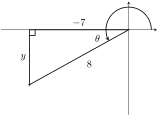
Let \(\theta\) be in quadrant III with \(\cos{\theta}=-\frac{7}{8}\text{.}\) Find \(\cos\brac{\theta+\frac{\pi}{6}}\) in exact value.
To find \(\cos\brac{\theta+\frac{\pi}{6}}\text{,}\) use the sum identity,
\begin{align*} \cos\brac{\theta+\frac{\pi}{6}} \amp = \cos\theta\cos\frac{\pi}{6}-\sin\theta\sin\frac{\pi}{6} \end{align*}
We know \(\cos{\frac{\pi}{6}}\text{,}\) \(\sin{\frac{\pi}{6}}\text{,}\) and we are given \(\cos{\theta}\text{,}\) but we’re also going to need to find \(\sin{\theta}\text{.}\)
To do this, sketch the angle in standard position, which is in quadrant III. Since \(\cos{\theta}=-\frac{7}{8}\text{,}\) \(x=-7\) and \(r=8\text{.}\)
Then, find \(y\text{,}\) using \(x^2+y^2=r^2\text{,}\)
\begin{align*} (-7)^2+y^2\amp=8^2\\ 49+y^2\amp=64\\ y^2\amp=15\\ y\amp=\pm\sqrt{15} \end{align*}
Since \(\theta\) is in quadrant III, \(y\) must be negative, so \(y=-\sqrt{15}\text{.}\) Then, \(\sin\theta=\frac{y}{r}=-\frac{\sqrt{15}}{8}\text{.}\) Then,
\begin{align*} \cos\brac{\theta+\frac{\pi}{6}}\amp=\cos\theta\cos\frac{\pi}{6}-\sin\theta\sin\frac{\pi}{6}\\ \amp=\brac{-\frac{7}{8}}\brac{\frac{\sqrt{3}}{2}}-\brac{-\frac{\sqrt{15}}{8}}\brac{\frac{1}{2}}\\ \amp=-\frac{7\sqrt{3}}{16}+\frac{\sqrt{15}}{16}\\ \amp=\boxed{\frac{\sqrt{15}-7\sqrt{3}}{16}} \end{align*}
In general, use a sum/difference identity to split into two angles.
  • If it’s a special angle, evaluate it directly.
  • If it’s a variable angle, sketch it, create a triangle with \(x, y\text{,}\) and \(r\text{,}\) and solve for the unknown side. Don’t forget a negative sign if \(x\) or \(y\) is negative!

Exercise Group 15.3.2. Find Exact Trigonometric Ratios.

Find the desired trigonometric ratios in exact value, from the given information.
(a)
Let \(\theta\) be in quadrant IV with \(\cos{\theta} = \frac{3}{5}\text{.}\) Find \(\cos{\brac{\theta + \frac{\pi}{3}}}\text{.}\)
Answer.
\(\frac{3 + 4\sqrt{3}}{10}\)
(b)
Given that \(\tan{x} = -1\text{,}\) find \(\tan{\brac{\frac{\pi}{3} + x}}\text{.}\)
Answer.
\(\frac{\sqrt{3} - 1}{1 + \sqrt{3}}\) or \(2 - \sqrt{3}\)
(c)
Given that \(\sin{x}=\frac{4}{5}\) and \(x\) is in quadrant I, find \(\sin\brac{x+\frac{\pi}{6}}\text{.}\)
Answer.
\(\frac{4\sqrt{3}+3}{10}\)
(d)
Given that \(\tan{A} = -\frac{1}{4}\) and \(A\) is in quadrant 2, and \(\cos{B} = \frac{2}{5}\) and \(B\) is in quadrant 4, find \(\cos{(A - B)}\text{.}\)
Answer.
\(\frac{-8-\sqrt{21}}{5\sqrt{17}}\)
(e)
Given that \(\tan{x}=3\text{,}\) find \(\tan\brac{x+\frac{\pi}{4}}\text{.}\)
Answer.
\(-2\)
(f)
Given that \(\cos{x}=\frac{12}{13}\) and \(x\) is in quadrant I, find \(\cos\brac{x+\frac{2\pi}{3}}\text{.}\)
Answer.
\(\frac{-12-5\sqrt{3}}{26}\)
(g)
If both \(A\) and \(B\) are third quadrant angles and \(\cos{B}=-\frac{12}{13}\text{,}\) find \(\sin\brac{A-B}\) if \(\sin{A}=-\frac{3}{5}\text{.}\)
Answer.
\(\frac{16}{65}\)
(h)
Given that \(\sin{\theta} = -\frac{4}{5}\) and \(\theta\) is in quadrant III, find \(\cos{\brac{\theta+\frac{\pi}{6}}}\text{.}\)
Answer.
\(\frac{-3\sqrt{3}-4}{10}\)

Exercise Group 15.3.3. Find Exact Trigonometric Ratios 2.

Find the desired trigonometric ratios in exact value, from the given information.
(a)
Given that \(\tan{A}=\frac{5}{12}\) and \(A\) is in quadrant III, and \(\cos{B}=-\frac{3}{5}\) and \(B\) is in quadrant II, find \(\sin{(A-B)}\text{.}\)
Answer.
\(\frac{63}{65}\)
(b)
Given that \(\sin{A}=\frac{12}{13}\) and \(A\) is in quadrant II, and \(\sec{B}=\frac{5}{4}\) and \(B\) is in quadrant IV, find \(\cos\brac{A+B}\text{.}\)
Answer.
\(\frac{16}{65}\)
(c)
Let \(x, y\) both be in quadrant I, with \(\sin{x} = \frac{1}{5}, \cos{y} = \frac{2}{3}\text{.}\) Find \(\sin{(x+y)}\) and \(\cos{(x-y)}\text{.}\)
Answer.
\(\sin{(x+y)} = \frac{2+2\sqrt{30}}{15}, \cos{(x-y)} = \frac{4\sqrt{6} + \sqrt{5}}{15}\)
(d)
Given \(A\) is in quadrant 2 and \(\sin{A}=\frac{1}{\sqrt{10}}\text{,}\) and \(B\) is in quadrant 3 and \(\cos{B}=-\frac{5}{7}\text{,}\) find \(\cos{(A+B)}, \sin{(A-B)}\text{,}\) and \(\tan{(A+B)}\text{.}\)
Answer.
\(\cos{(A+B)}=\frac{15+2\sqrt{6}}{7\sqrt{10}}\) (or rationalized is \(\frac{105\sqrt{10}+28\sqrt{15}}{490}\)), \(\sin{(A-B)}=\frac{-5-6\sqrt{6}}{7\sqrt{10}}\) (or rationalized \(\frac{-35\sqrt{10}-84\sqrt{15}}{490}\)), \(\tan{(A+B)} = \frac{-5+6\sqrt{6}}{15+2\sqrt{6}}\)
(e)
If \(\sin{\alpha} = \frac{3}{5}\) and \(\sin{\beta} = -\frac{12}{13}\text{,}\) with \(\alpha\) in quadrant II and \(\beta\) in quadrant IV, find \(\sin{\brac{\alpha - \beta}}\text{.}\)
Answer.
\(-\frac{33}{65}\)
(f)
Given \(\alpha\) is in quadrant II with \(\sin{\alpha} = \frac{1}{\sqrt{10}}\) and \(\beta\) is in quadrant III with \(\cos{\beta} = -\frac{5}{7}\text{,}\) find \(\sin{(\alpha + \beta)}, \cos{(\alpha + \beta)}\text{,}\) and \(\tan{(\alpha + \beta)}\text{.}\)
Answer.
\(\sin{(\alpha + \beta)} = \frac{-5-6\sqrt{6}}{7\sqrt{10}}\) (or rationalized \(\frac{-5\sqrt{10} + 12\sqrt{15}}{70}\)), \(\cos{(\alpha + \beta)} = \frac{15 + 2\sqrt{6}}{7\sqrt{10}}\) (or rationalized \(\frac{15\sqrt{10} + 4\sqrt{15}}{70}\)), \(\tan{(\alpha + \beta)} = \frac{-5 + 6\sqrt{6}}{15 + 2\sqrt{6}}\) (or rationalized \(\frac{-147 + 100\sqrt{6}}{201}\))
Could also use inverse trig function and reference angle.

Subsection 15.3.3 Simplifying Expressions Using Sum and Difference Identities

Exercise Group 15.3.4. Simplifying Expressions.

Write each expression as a single trigonometric function.
(a)
\(\sin 28^\circ \cos 35^\circ + \cos 28^\circ \sin 35^\circ\)
Answer.
\(\sin 63^\circ\)
(b)
\(\cos 10^\circ \cos 7^\circ - \sin 10^\circ \sin 7^\circ\)
Answer.
\(\cos 17^\circ\)
(c)
\(\sin \frac{\pi}{3} \cos \frac{\pi}{4} - \cos \frac{\pi}{3} \sin \frac{\pi}{4}\)
Answer.
\(\sin \brac{\frac{\pi}{12}}\)

Exercise Group 15.3.5. Simplify and Find Exact Values.

Simplify and find an exact value for each expression.
(a)
\(\cos{25^\circ}\cos{5^\circ} - \sin{25^\circ}\sin{5^\circ}\)
Hint.
\(= \cos{(25^\circ + 5^\circ)}\)
Answer.
\(\frac{\sqrt{3}}{2}\)
(b)
\(\sin{40^\circ}\cos{20^\circ} + \cos{40^\circ}\sin{20^\circ}\)
Hint.
\(= \sin{(40^\circ + 20^\circ)}\)
Answer.
\(\frac{\sqrt{3}}{2}\)
(c)
\(\sin{\frac{\pi}{3}}\cos{\frac{\pi}{6}} + \cos{\frac{\pi}{3}}\sin{\frac{\pi}{6}}\)
Hint.
\(= \sin{(\frac{\pi}{3} + \frac{\pi}{6})}\)
Answer.
\(1\)
(d)
\(\cos{\frac{7\pi}{12}}\cos{\frac{\pi}{3}} + \sin{\frac{7\pi}{12}}\sin{\frac{\pi}{3}}\)
Hint.
\(= \cos{(\frac{7\pi}{12} - \frac{\pi}{3})}\)
Answer.
\(\frac{\sqrt{2}}{2}\)
(f)
\(\cos{40^\circ}\cos{20^\circ} - \sin{40^\circ}\sin{20^\circ}\)
Hint.
\(= \cos{(40^\circ + 20^\circ)}\)
Answer.
\(\frac{1}{2}\)
(g)
\(\cos{\frac{\pi}{12}}\cos{\frac{\pi}{4}} + \sin{\frac{\pi}{12}}\sin{\frac{\pi}{4}}\)
Hint.
\(= \cos{(\frac{\pi}{12} - \frac{\pi}{4})}\)
Answer.
\(\frac{\sqrt{3}}{2}\)
(h)
\(\cos{\frac{\pi}{3}}\cos{\frac{5\pi}{6}} + \sin{\frac{\pi}{3}}\sin{\frac{5\pi}{6}}\)
Hint.
\(= \cos{(\frac{\pi}{3} - \frac{5\pi}{6})}\)
Answer.
\(0\)
(i)
\(\sin{\frac{2\pi}{3}}\cos{\frac{\pi}{6}} - \cos{\frac{2\pi}{3}}\sin{\frac{\pi}{6}}\)
Hint.
\(= \sin{(\frac{2\pi}{3} - \frac{\pi}{6})}\)
Answer.
\(1\)
(j)
\(\frac{\tan{\frac{\pi}{3}} - \tan{\frac{\pi}{6}}}{1 + \tan{\frac{\pi}{3}}\tan{\frac{\pi}{6}}}\)
Hint.
\(= \tan{(\frac{\pi}{3} - \frac{\pi}{6})}\)
Answer.
\(\frac{\sqrt{3}}{3}\)

Exercise Group 15.3.6. Simplify Expressions with Identities.

Simplify each expression using a sum or difference identity.
(f)
\(\sin{\brac{x + \frac{\pi}{4}}}\)
Answer.
\(\frac{\sqrt{2}}{2} \sin{x} + \frac{\sqrt{2}}{2} \cos{x}\)

Exercise Group 15.3.7. Simplify to Single Function.

Simplify each expression into a single trigonometric function.
(a)
\(\cos{(7x)} \cos{(5x)} - \sin{(7x)} \sin{(5x)}\)
Answer.
\(\cos{(12x)}\)
(b)
\(\sin{(2x)} \sin{(3x)} - \cos{(2x)} \cos{(3x)}\)
Answer.
\(-\cos{(5x)}\)
(c)
\(\cos{(3x)} \cos{x} - \sin{(3x)} \sin{x}\)
Answer.
\(\cos{(4x)}\)
(d)
\(\cos{(2x)} \cos{x} + \sin{(2x)} \sin{x}\)
Answer.
\(\cos{x}\)

Exercise Group 15.3.8. Simplify Expressions.

Simplify each expression.
(a)
\(\frac{\sin{(3x)}}{\csc{x}}-\frac{\cos{(3x)}}{\sec{x}}\)
Answer.
\(-\cos{(4x)}\)
(b)
\(\cos{(A+B)}\cos{(B)}+\sin{(A+B)}\sin{(B)}\)
Answer.
\(\cos{A}\)
(c)
\(\tan^2\brac{\frac{\pi}{2}-x}\cdot\sec^2{x}-\sin^2\brac{\frac{\pi}{2}-x}\cdot\csc^2{x}\)
Answer.
\(1\)
(d)
\(\sin\brac{\frac{\pi}{3}-x}\cdot\cos\brac{\frac{\pi}{3}+x}+\cos\brac{\frac{\pi}{3}-x}\cdot\sin\brac{\frac{\pi}{3}+x}\)
Answer.
\(\frac{\sqrt{3}}{2}\)

Subsection 15.3.4 Proving Identities with Sum and Difference Examples

Exercise Group 15.3.9. Proving Identities.

Prove each trigonometric identity.
(a)
\(\cos(x+y)\cos(x-y)=\cos^{2}x-\sin^{2}y\)
Hint.
sum and difference identity, expand, collect like terms.
(b)
\(\sin{(x+y)} \sin{(x-y)} = \sin^2{x} - \sin^2{y}\)
Hint.
sum and difference identity, expand, collect like terms, Pythagorean identity.
(c)
\(\sin{(x+y)} + \sin{(x-y)}=2\sin{x}\cos{y}\)
Hint.
sum and difference identity, collect like terms.
(d)
\(\csc^2\brac{\frac{\pi}{2}-x}-1=\tan^2{x}\)
Hint.
rewrite in terms of sine and cosine, sum and difference identity.
(e)
\(\sin{(x+y)}-\sin{(x-y)}=2\sin{y}\cos{x}\)
(f)
\(\frac{\sin{(x+y)}}{\cos{(x-y)}}=\frac{\cot{x}+\cot{y}}{1+\cot{x}\cot{y}}\)
(g)
\(\frac{\sin{(x-y)}}{\sin{y}}+\frac{\cos{(x-y)}}{\cos{y}}=\frac{\sin{x}}{\sin{y}\cos{y}}\)
(h)
\(\frac{1+\tan{x}}{\tan\brac{x+\frac{\pi}{4}}}=1-\tan{x}\)
(i)
\(\sin{(x+y)}\sin{(x-y)}=\sin^2{x}-\sin^2{y}\)
(j)
\(\cos{(x+y)}\cos{(x-y)}=\cos^2{x}-\sin^2{y}\)
(k)
\(\sec{(x+y)}=\frac{\sec{x}\sec{y}}{1-\tan{x}\tan{y}}\)
(l)
\(\csc{(x-y)}=\frac{\csc{x}\csc{y}}{\cot{y}-\cot{x}}\)

Subsection 15.3.5 Solving Equations Using the Sum and Difference Identities

Exercise Group 15.3.10. Solving Equations.

Solve each equation, for \(0 \leq x \lt 2\pi\) (or \(\ang{0} \leq x \lt \ang{360}\)).
(a)
\(\cos{(2x)} \cos{x} - \sin{(2x)} \sin{x} = 0\)
Answer.
\(x=\frac{\pi}{6},\frac{\pi}{2},\frac{5\pi}{6},\frac{7\pi}{6},\frac{3\pi}{2},\frac{11\pi}{6}\)
(b)
\(\sin\brac{x + \frac{\pi}{4}} = \sqrt{2} \cos{x}\)
Answer.
\(x=\frac{\pi}{4},\frac{5\pi}{4}\)
(c)
\(\frac{\tan{(4x)} - \tan{(3x)}}{1 + \tan{(4x)} \tan{(3x)}} = \sqrt{3}\)
Answer.
\(x=\frac{\pi}{3},\frac{4\pi}{3}\)
(d)
\(\sin{\brac{x + \frac{\pi}{4}}} + \sin{\brac{x - \frac{\pi}{4}}} = -1\)
Answer.
\(x=\frac{5\pi}{4},\frac{7\pi}{4}\)
(e)
\(2\tan{x} + \tan{(\pi - x)} = \sqrt{3}\)
Answer.
\(x=\frac{\pi}{3},\frac{4\pi}{3}\)
(f)
\(\cos{x}\cos{10^\circ}-\sin{x}\sin{10^\circ}=\frac{1}{2}\)
Answer.
\(x=50^\circ,290^\circ\)
(g)
\(\sin{x}\cos{12^\circ}+\cos{x}\cos{78^\circ}=\frac{\sqrt{3}}{2}\)
Answer.
\(x=48^\circ,108^\circ\)
(h)
\(\cos{3x}\cos{x}+\sin{3x}\sin{x}=0\)
Answer.
\(x=\frac{\pi}{4},\frac{3\pi}{4},\frac{5\pi}{4},\frac{7\pi}{4}\)
(i)
\(2\tan{x}+\tan\brac{\pi-x}=\sqrt{3}\)
Answer.
\(x=\frac{\pi}{3},\frac{4\pi}{3}\)
(j)
\(\sqrt{2}\sin{3x}\cos{2x}=1+\sqrt{2}\cos{3x}\sin{2x}\)
Answer.
\(x=\frac{\pi}{4},\frac{3\pi}{4}\)
(k)
\(\cos\brac{x+\frac{\pi}{4}}+\cos\brac{x-\frac{\pi}{4}}=1\)
Answer.
\(x=\frac{\pi}{4},\frac{7\pi}{4}\)

Subsection 15.3.6 Other Examples

Exercise Group 15.3.11. Properties of Trigonometric Functions.

Find the amplitude, period, and phase shift of each function.
(a)
\(y=\cos{3x}\cos{x}-\sin{3x}\sin{x}\)
Answer.
\(y=\cos{4x}\text{,}\) amplitude is 1, period is \(\frac{\pi}{2}\text{,}\) phase shift is 0
(b)
\(f(x)=3\sin\brac{\frac{\pi}{6}x}\cos\brac{\frac{\pi}{3}}+3\cos\brac{\frac{\pi}{6}x}\sin\brac{\frac{\pi}{3}}\)
Answer.
\(f(x)=3\sin\brac{\frac{\pi}{6}(x+2)}\text{,}\) amplitude is 3, period is 12, phase shift is left 2
(c)
\(y=3\sin\brac{\frac{\pi}{6}x}\cos\brac{\frac{\pi}{3}}+3\cos\brac{\frac{\pi}{6}x}\sin\brac{\frac{\pi}{3}}\)
Answer.
\(y=3\sin\brac{\frac{\pi}{6}(x+2)}\text{,}\) amplitude is 3, period is 12, phase shift is left 2
(d)
\(f(x)=3\sqrt{2}\sin\brac{2x}\cos\brac{\frac{\pi}{4}}+3\sqrt{2}\cos\brac{2x}\sin\brac{\frac{\pi}{4}}\)
Answer.
\(f(x)=3\sqrt{2}\sin\brac{2\brac{x+\frac{\pi}{8}}}\text{,}\) amplitude is \(3\sqrt{2}\text{,}\) period is \(\pi\text{,}\) phase shift is left \(\frac{\pi}{8}\)
(e)
\(y=-2\sin{2x}\cos\brac{\frac{\pi}{3}}+2\cos{2x}\sin\brac{\frac{\pi}{3}}\)
Answer.
\(y=2\cos\brac{2x+\frac{\pi}{6}}=2\cos\brac{2\brac{x+\frac{\pi}{12}}}\text{,}\) amplitude is 2, period is \(\pi\text{,}\) phase shift is left \(\frac{\pi}{12}\)
(f)
\(y=-\sin\brac{\frac{\pi}{4}x}\sin\brac{\frac{\pi}{2}}-\cos\brac{\frac{\pi}{4}x}\cos\brac{\frac{\pi}{2}}\)
Answer.
\(y=-\sin\brac{\frac{\pi}{4}x}=\sin\brac{\frac{\pi}{4}(x+4)}\text{,}\) amplitude is 1, period is 8, phase shift is left 4

