Skip to main content
Contents Dark Mode Prev Up Next \(\newcommand{\N}{\mathbb N}
\newcommand{\Z}{\mathbb Z}
\newcommand{\Q}{\mathbb Q}
\newcommand{\R}{\mathbb R}
\newcommand{\abs}[1]{\left\lvert #1 \right\rvert}
\newcommand{\set}[1]{\left\{ #1 \right\}}
\renewcommand{\neg}{\sim}
\newcommand{\brac}[1]{\left( #1 \right)}
\newcommand{\rad}[1]{#1 \ \text{rad}}
\newcommand{\eval}[1]{\left. #1 \right|}
\newcommand{\floor}[1]{\left\lfloor #1 \right\rfloor}
\newcommand{\ceil}[1]{\left\lceil #1 \right\rceil}
\newcommand{\ang}[1]{#1^\circ}
\newcommand{\crossmethod}[4]{
\begin{tikzpicture}[baseline=(M.base)]
\node (M) at (0,0) {$#1$};
\node (P) at (0,-1) {$#2$};
\node (N) at (1.5,0) {$#3$};
\node (Q) at (1.5,-1) {$#4$};
\draw (M) -- (Q);
\draw (P) -- (N);
\end{tikzpicture}
}
\newcommand{\lt}{<}
\newcommand{\gt}{>}
\newcommand{\amp}{&}
\definecolor{fillinmathshade}{gray}{0.9}
\newcommand{\fillinmath}[1]{\mathchoice{\colorbox{fillinmathshade}{$\displaystyle \phantom{\,#1\,}$}}{\colorbox{fillinmathshade}{$\textstyle \phantom{\,#1\,}$}}{\colorbox{fillinmathshade}{$\scriptstyle \phantom{\,#1\,}$}}{\colorbox{fillinmathshade}{$\scriptscriptstyle\phantom{\,#1\,}$}}}
\)
Section 6.2 Radical Expressions Summary
Adding/subtracting like radicals
\(\rightarrow\) add the front numbers
Multiply radicals
\(\rightarrow\) multiply everything together
Subsection 6.2.1 Examples
Example 6.2.1 .
A rectangle has dimensions
\(6+\sqrt{3}\) and
\(6-\sqrt{3}\text{.}\) Find its area.
Example 6.2.2 .
Show that the reciprocal of
\(\sqrt{26}-5\) is 10 greater than
\(\sqrt{26}-5\text{.}\)
Hint .
Take the reciprocal and rationalize the denominator.
Example 6.2.3 .
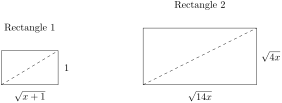
Determine the value of
\(x\) if the diagonal of Rectangle 2 is three times the length of the diagonal of Rectangle 1.
Figure 6.2.4. Two rectangles with radical dimensions
Hint .
First find an expression for each diagonal, using the Pythagorean theorem, then set up an equation.
Answer .
Example 6.2.5 .
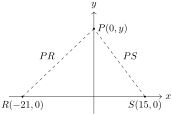
The point
\(P\) lies on the
\(y\) -axis. The coordinates of
\(R\) and
\(S\) are
\((-21, 0)\) and
\((15, 0)\) respectively. The sum of
\(PR\) and
\(PS\) is 54 units. Determine the coordinates of
\(P\text{.}\)
Figure 6.2.6. Point P on the y-axis with distances to R and S
Hint .
Using the distance formula,
\(\sqrt{441+y^2}+\sqrt{225+y^2}=54\text{,}\) then solve for
\(y\text{.}\)
Answer .
\(P = (0, 20)\) or
\(P = (0, -20)\)
Example 6.2.7 .
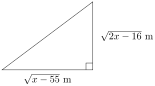
The area of the given triangle is 30 m
\(^2\text{.}\) Determine the value of
\(x\text{.}\)
Figure 6.2.8. Right triangle with radical side lengths
Hint .
Use the triangle area formula
\(A = \frac{1}{2}bh\text{,}\) then solve the resulting quadratic equation.
Answer .