Section 8.2 The Ambiguous Case (SSA)

Until now, knowing the information of the triangle allowed us to solve it completely. However, there is one case where the information could lead to 2 different possible triangles. In particular, when given 2 sides an a non-included angle (the SSA case), there could be 2 triangles, or even 0 possible triangles. This is called the ambiguous case, because it’s not clear what the triangle is, or even if one exists.

Example 8.2.1.

Consider a triangle with angle \(A = 40^\circ\text{,}\) side \(a = 7\text{,}\) and side \(b = 10\text{.}\) How many triangles are possible, and what are their dimensions?
Solution.
There is a systematic way to solve problems with the ambiguous case. While it’s not absolutely necessary, it helps to keep things organized. First, sketch the known angle (\(A = 40^\circ\)) in the bottom-left corner, with side \(b = 10\) above it, and the unknown side \(c\) horizontally. You should have something like this,
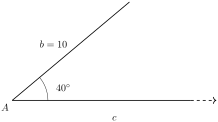
Notice that the bottom length \(c\) is unknown, so just extend it a bit to the right (we don’t know how long). Then, the other side \(a\) is opposite angle \(A\text{,}\) so it’ll go from the top point down to the right.
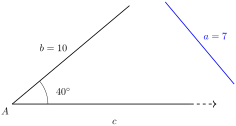
You should aim to sketch \(a\) so it’s a bit shorter than \(b\) (because 7 is smaller than 10), however, it doesn’t have to be perfect. Now, attach side \(a\) to point \(B\) and swing it down until it touches the base \(c\text{,}\)
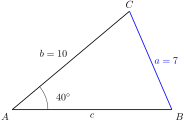
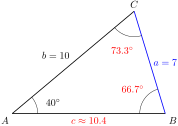
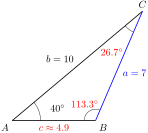
Now, we have one triangle. However, this is not the only possibility! In fact, \(a\) can swing the other way to create a different triangle,
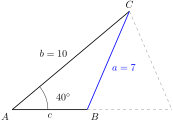
This setup also works with the given measurements. Therefore, there are 2 possible triangles with the given information.
Now, to solve both triangles, we can work on them side-by-side. On your paper, draw a vertical line down the middle. The left column is for Triangle 1 (where \(a\) swings to the right), and the right column is for Triangle 2 (where \(a\) swings to the left). We’ll do the same steps for both, and the only difference is whether we use the angle from inverse sine directly, or its supplement.
First, use the law of sines to find \(\sin{B}\text{.}\) This step is the same for both triangles,
\begin{align*} \frac{7}{\sin{40^\circ}} \amp= \frac{10}{\sin{B}}\\ \sin{B} \amp= \frac{10 \sin{40^\circ}}{7} \approx 0.9165 \end{align*}
Now, here’s where the two triangles differ. Recall that \(\sin^{-1}(0.9165) \approx 66.7^\circ\text{,}\) but there are two angles with the same sine value: \(66.7^\circ\) and its supplement \(180^\circ - 66.7^\circ = 113.3^\circ\text{.}\) You can organize the 2 triangles nicely in 2 columns,
Triangle 1 Triangle 2
\(B_1 \approx 66.7^\circ\)
\(B_2 \approx 180^\circ - 66.7^\circ = 113.3^\circ\)
Find \(C_1\text{:}\)
Find \(C_2\text{:}\)
\(C_1 = 180^\circ - 40^\circ - 66.7^\circ\)
\(C_2 = 180^\circ - 40^\circ - 113.3^\circ\)
\(C_1 \approx 73.3^\circ\)
\(C_2 \approx 26.7^\circ\)
Find \(c_1\) using law of sines:
Find \(c_2\) using law of sines:
\(c_1 = \dfrac{7 \sin{73.3^\circ}}{\sin{40^\circ}} \approx 10.4\)
\(c_2 = \dfrac{7 \sin{26.7^\circ}}{\sin{40^\circ}} \approx 4.9\)
In summary,
Figure 8.2.2. Triangle 1
Figure 8.2.3. Triangle 2

Example 8.2.4.

However, there are not always 2 solutions.
How can you tell how many triangles there are? It will always be the SSA (or ASS) case that is ambiguous. First, calculate the height \(h = b \sin{A}\text{.}\) Then, compare \(a\) to \(h\) and \(b\) to determine the number of solutions.
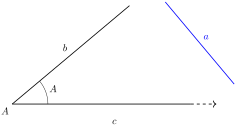
In general, if \(A\) is the known angle, and \(a, b\) are the known sides. Sketch the angle \(A\) in the bottom-left corner, the side \(b\) above, the base along the bottom of unknown length, and side \(a\) will be opposite \(A\text{.}\)
To determine how many triangles are possible, first calculate the height \(h\) of the triangle, using \(h = b \sin{A}\text{.}\) Then, compare the measurements:
  1. If \(a \lt h\text{,}\) then there are 0 solutions. The side \(a\) is too short to reach the base.
  2. If \(h \lt a \lt b\text{,}\) then there are 2 solutions. The side \(a\) is longer than \(h\text{,}\) but shorter than \(b\text{.}\) Basically, side \(a\) can swing in 2 different directions.
  3. If \(a = h\text{,}\) then there is 1 solution, and it’s a right triangle.
  4. If \(a \geq b\text{,}\) then there is 1 triangle.
Here is a number line for the length \(a\) showing the different cases,
  • Here is a Desmos applet for visualizing the ambiguous case: SSA Ambiguous Case. Input your given values for angle \(A\text{,}\) side \(b\text{,}\) and side \(a\) to see how many triangles are possible.
  • Here is another applet for visualizing the ambiguous case: SSA triangle: The Ambiguous Case.
  • If the given angle is obtuse, there can be at most 1 triangle.

Subsection 8.2.1 Examples

Exercise Group 8.2.1. Determining Number of Solutions.

For each triangle, determine whether there is no solution, one solution, or two solutions.
(a)
In \(\triangle ABC\text{,}\) \(\angle A = 39^\circ\text{,}\) \(a = 10\) cm, and \(b = 14\) cm.
Hint.
\(h = b\sin{A}\)
Answer.
2 solutions (\(h \approx 8.81\text{,}\) and \(h \lt a \lt b\))
(b)
In \(\triangle ABC\text{,}\) \(\angle A = 123^\circ\text{,}\) \(a = 23\) cm, and \(b = 12\) cm.
Hint.
obtuse angle
Answer.
1 solution (\(A\) is obtuse and \(a \gt b\))
(c)
In \(\triangle ABC\text{,}\) \(\angle A = 145^\circ\text{,}\) \(a = 18\) cm, and \(b = 10\) cm.
Answer.
1 solution (\(A\) is obtuse and \(a \gt b\))
(d)
In \(\triangle ABC\text{,}\) \(\angle A = 124^\circ\text{,}\) \(a = 1\) cm, and \(b = 2\) cm.
Answer.
no solution (\(h \approx 1.66\) and \(a \lt h\text{,}\) so \(a\) is too short)

Exercise Group 8.2.2. Solving Triangles with Ambiguous Case.

Determine the unknown side and angles in each triangle. If two solutions are possible, give both.
(a)
In \(\triangle ABC\text{,}\) \(\angle C = 31^\circ\text{,}\) \(a = 5.6\) cm, and \(c = 3.9\) cm.
Answer.
Two solutions. Triangle 1: \(A_1 \approx 47.6^\circ\text{,}\) \(B_1 \approx 101.4^\circ\text{,}\) \(b_1 \approx 7.4\) cm. Triangle 2: \(A_2 \approx 132.4^\circ\text{,}\) \(B_2 \approx 16.6^\circ\text{,}\) \(b_2 \approx 2.2\) cm.
(b)
In \(\triangle PQR\text{,}\) \(\angle Q = 43^\circ\text{,}\) \(p = 20\) cm, and \(q = 15\) cm.
Answer.
Two solutions. Triangle 1: \(P_1 \approx 65.4^\circ\text{,}\) \(R_1 \approx 71.6^\circ\text{,}\) \(r_1 \approx 20.9\) cm. Triangle 2: \(P_2 \approx 114.6^\circ\text{,}\) \(R_2 \approx 22.4^\circ\text{,}\) \(r_2 \approx 8.4\) cm.
(c)
In \(\triangle XYZ\text{,}\) \(\angle X = 53^\circ\text{,}\) \(x = 8.5\) cm, and \(z = 12.3\) cm.
Answer.
No solution (\(\sin{Z} \approx 1.16 \gt 1\))
(d)
In triangle \(\triangle ABC\text{,}\) \(A = 30^\circ\text{,}\) \(a = 4\text{,}\) and \(b = 5\text{.}\)
Answer.
Two solutions. Triangle 1: \(B_1 \approx 38.7^\circ\text{,}\) \(C_1 \approx 111.3^\circ\text{,}\) \(c_1 \approx 7.5\text{.}\) Triangle 2: \(B_2 \approx 141.3^\circ\text{,}\) \(C_2 \approx 8.7^\circ\text{,}\) \(c_2 \approx 1.2\text{.}\)

Exercise Group 8.2.3. Solve Each Triangle.

Solve each triangle, if possible.
(a)
\(A = 110^\circ\text{,}\) \(c = 19\text{,}\) \(a = 32\text{.}\)
Answer.
\(C \approx 33.9^\circ\text{,}\) \(B \approx 36.1^\circ\text{,}\) \(b \approx 20.1\)
(b)
\(A = 131^\circ\text{,}\) \(a = 25\text{,}\) \(c = 8\text{.}\)
Hint.
obtuse case
Answer.
\(C \approx 14.0^\circ\text{,}\) \(B \approx 35.0^\circ\text{,}\) \(b \approx 19.0\)