Notice that \(V_{\text{cone}} = \frac{1}{3} A h\text{,}\) where \(A = \pi r^2\) is the area of the base. This is the same formula as the volume of a pyramid. In fact, a cone can be thought of as a pyramid with a circular base.
Section 3.5 Cones
A cone is a 3D object with a round base, and a curved surface that goes to a point.
A cone can be thought of as a pyramid with a circular base. Just like pyramids,
-
The tip of the cone is called the apex (just like a pyramid).
-
The height is the distance from the apex to the base.
-
The slant height is the length along the side of the cone.
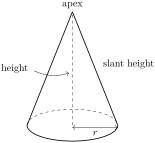
We will only consider a cone with a circular base, and whose tip is right above the center of the base, which is called a right circular cone (or simply right cone).
Subsection 3.5.1 Volume of a Cone
Recall that the volume of a pyramid is \(\frac{1}{3}\) the volume of a prism with the same base and height. The same relationship holds for cones and cylinders.
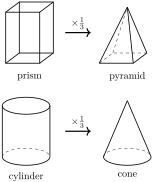
The volume of a right circular cone is,
\begin{equation*}
\boxed{V_{\text{cone}} = \frac{1}{3} \pi r^2 h \quad \begin{cases} r \rightarrow \text{radius} \\ h \rightarrow \text{height} \end{cases}}
\end{equation*}
Remark 3.5.1.
Example 3.5.2. Volume of a Cone.
Find the volume of a cone with radius 6 cm and height 10 cm.

\begin{align*}
V \amp= \frac{1}{3}\pi r^2 h\\
\amp= \frac{1}{3}\pi(6)^2(10)\\
\amp= \frac{1}{3}\pi(36)(10)\\
\amp= \frac{360\pi}{3}\\
\amp= 120\pi\\
\amp\approx 376.99 \text{ cm}^3
\end{align*}
Example 3.5.3. Application: Ice Cream Cone.
An ice cream cone has diameter 5 cm and height 12 cm. How many cm\(^3\) of ice cream can it hold?

First, \(r = \frac{d}{2} = \frac{5}{2} = 2.5\) cm. The volume is,
\begin{align*}
V \amp= \frac{1}{3}\pi r^2 h\\
\amp= \frac{1}{3}\pi(2.5)^2(12)\\
\amp= \frac{1}{3}\pi(6.25)(12)\\
\amp= \frac{75\pi}{3}\\
\amp= 25\pi\\
\amp\approx 78.5 \text{ cm}^3
\end{align*}
Example 3.5.4. Comparing Cone and Cylinder.
A cone and a cylinder both have diameter 5 cm and height 12 cm. How do their volumes compare?
The cylinder has volume,
\begin{equation*}
V_{\text{cylinder}} = \pi r^2 h = \pi(2.5)^2(12) = 75\pi \approx 235.6 \text{ cm}^3
\end{equation*}
The cone has volume,
\begin{equation*}
V_{\text{cone}} = \frac{1}{3}\pi r^2 h = \frac{1}{3}\pi(2.5)^2(12) = 25\pi \approx 78.5 \text{ cm}^3
\end{equation*}
Indeed, \(V_{\text{cone}} = \frac{1}{3} V_{\text{cylinder}}\text{.}\) It would take exactly 3 cones of water to fill the cylinder.
Subsection 3.5.2 Surface Area of a Cone
Consider the surface area of a cone. Intuitively, a cone is a pyramid, where the number of sides of the base of the pyramid is large.
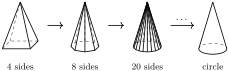
Recall that the surface area of a pyramid is given by,
\begin{equation*}
SA_{\text{pyramid}} = \frac{1}{2} s P + \brac{\text{area of base}}
\end{equation*}
Then, for a cone, it has a circular base, which has a radius \(r\text{.}\) Then, \(P = 2\pi r\) is the circumference of a circle, and \(A_B = \pi r^2\) is the area of the base. Putting these together, we get,
\begin{align*}
SA_{\text{cone}} \amp= \frac{1}{2} s (2\pi r) + \pi r^2\\
\amp= \pi rs + \pi r^2
\end{align*}
The surface area of a right circular cone is,
\begin{equation*}
\boxed{SA_{\text{cone}} = \pi rs + \pi r^2 \quad \begin{cases} r \rightarrow \text{radius} \\ s \rightarrow \text{slant height} \end{cases}}
\end{equation*}
-
\(\pi rs\) is the lateral surface area (the curved surface only, not the base).
-
\(\pi r^2\) is the area of the circular base.
If the height \(h\) of the cone is given, then by the Pythagorean theorem, \(s^2 = r^2 + h^2\text{,}\) so \(s = \sqrt{r^2 + h^2}\text{.}\) Then, the formula can be written in terms of \(h\) as,
\begin{equation*}
SA = \pi r \sqrt{r^2 + h^2} + \pi r^2
\end{equation*}
Example 3.5.7. Surface Area: Slant Height Given.
Find the surface area of a cone with radius 4 cm and slant height 7 cm.

\begin{align*}
SA \amp= \pi rs + \pi r^2\\
\amp= \pi(4)(7) + \pi(4)^2\\
\amp= 28\pi + 16\pi\\
\amp= 44\pi\\
\amp\approx 138.2 \text{ cm}^2
\end{align*}
Example 3.5.8. Surface Area: Height Given (Must Find Slant Height).
Find the surface area of a cone with radius 5 cm and height 12 cm.

First, find the slant height using the Pythagorean theorem,
\begin{align*}
s \amp= \sqrt{r^2 + h^2}\\
\amp= \sqrt{5^2 + 12^2}\\
\amp= \sqrt{25 + 144}\\
\amp= \sqrt{169}\\
\amp= 13 \text{ cm}
\end{align*}
Now compute the surface area,
\begin{align*}
SA \amp= \pi rs + \pi r^2\\
\amp= \pi(5)(13) + \pi(5)^2\\
\amp= 65\pi + 25\pi\\
\amp= 90\pi\\
\amp\approx 282.7 \text{ cm}^2
\end{align*}
Subsection 3.5.3 Examples
Exercise Group 3.5.1. Surface Area of Cones.
Find the surface area of each cone. Give exact answers and decimal approximations.
(a)
Radius 3 cm, slant height 8 cm.

(b)
Diameter 27 cm, slant height 40 cm.
(c)
Radius 4.5 cm, slant height 9.5 cm.
(d)
Radius 8 cm, height 15 cm.
(e)
A party hat is a cone with no base. It has radius 10 cm and slant height 25 cm. Find the lateral surface area only.

Exercise Group 3.5.2. Volume of Cones.
Find the volume of each cone.
(a)
Radius 3 cm, height 7 cm.
(b)
Diameter 5.4 cm, height 7.5 cm.
(c)
Radius 10 cm, height 24 cm.
(d)
Diameter 12 cm, height 8 cm.
Exercise Group 3.5.3. Reverse Problems.
Find the missing dimension.
(a)
A cone has volume \(150\pi \text{ cm}^3\) and height 18 cm. Find the radius.
(b)
A cone has volume \(100 \text{ cm}^3\) and radius 4 cm. Find the height to the nearest tenth.
(c)
A cone has lateral surface area \(60\pi \text{ cm}^2\) and radius 5 cm. Find the slant height.
Exercise Group 3.5.4. Algebra Practice.
Find the missing dimension in each cone.
(a)
A right cone has \(SA = 7012 \text{ mm}^2\) and diameter 48 mm. Find the slant height.
(b)
A right cone has \(SA = 12 \text{ m}^2\) and radius 1.3 m. Find the slant height to the nearest tenth.
(c)
A plastic cone was immersed in a measuring cylinder containing water. The volume of the cone was determined to be \(33.5 \text{ cm}^3\text{,}\) and its diameter is 4.0 cm. What is the height of the cone to the nearest tenth?
(d)
A cone has a height of 8 m and a volume of \(300 \text{ m}^3\text{.}\) Find the radius of the base to the nearest metre.
Checkpoint 3.5.9. Finding Height from Volume.
A right cone has a volume of \(20 \text{ cm}^3\) and a diameter of 5 cm. Calculate its height to the nearest tenth.
Subsection 3.5.4 Word Problems
Example 3.5.10. Funnel.
A funnel is cone-shaped with diameter 16 cm and height 20 cm. How many mL of liquid can it hold?

Answer: \(r = 8\text{.}\) \(V = \frac{1}{3}\pi(64)(20) = \frac{1280\pi}{3} \approx 1340.4 \text{ cm}^3 = 1340.4 \text{ mL}\text{.}\)
Example 3.5.11. Cone and Cylinder Same Volume.
A cone and a cylinder have the same volume of \(300\pi \text{ cm}^3\) and the same radius of 10 cm. Find the height of each.
Answer: Cylinder: \(300\pi = \pi(100)h\text{,}\) so \(h = 3\) cm. Cone: \(300\pi = \frac{1}{3}\pi(100)h\text{,}\) so \(h = 9\) cm. The cone is 3 times as tall.
Example 3.5.12. Model Volcano.
A cone-shaped model volcano for a science project has a base diameter of 32 cm and a slant height of 45 cm.
-
What is the lateral area of the volcano to the nearest square centimetre?
-
Paint for the volcano costs $1.99 per jar, and one jar covers \(400 \text{ cm}^2\text{.}\) How much will the paint cost?
Answer: \(r = 16\text{.}\) \(A_L = \pi(16)(45) = 720\pi \approx 2262 \text{ cm}^2\text{.}\) Number of jars \(= 2262/400 \approx 5.7\) jars, round up to 6 jars. Cost \(= 6 \times \$1.99 = \$11.94\text{.}\)
Example 3.5.13. Road Pylon.
A road pylon approximates a right cone with height 53 cm and base diameter 18 cm. The lateral surface of the pylon is to be painted with reflective paint. What area will be painted, to the nearest square centimetre?
Answer: \(r = 9\text{.}\) \(s = \sqrt{53^2 + 9^2} = \sqrt{2809 + 81} = \sqrt{2890} \approx 53.8\) cm. \(A_L = \pi(9)(53.8) \approx 1521 \text{ cm}^2\text{.}\)
Example 3.5.14. Conical Tent with Hides.
A conical tent has a base diameter of 3.9 m and a height of 4.6 m. The tent cover is made from 15 tanned hides sewn together. To the nearest tenth of a square metre, what area does each hide cover?
Answer: \(r = 1.95\text{.}\) \(s = \sqrt{4.6^2 + 1.95^2} = \sqrt{21.16 + 3.80} = \sqrt{24.96} \approx 5.0\) m. \(A_L = \pi(1.95)(5.0) = 9.75\pi \approx 30.6 \text{ m}^2\text{.}\) Each hide covers \(\approx 30.6 / 15 \approx 2.0 \text{ m}^2\text{.}\)
Example 3.5.15. Grain Pile Surface Area.
A farmer unloaded grain onto a tarp on the ground. The grain formed a cone-shaped pile with a diameter of 12 ft and a height of 8 ft. Find the surface area of the exposed grain (lateral surface only) to the nearest square foot.
Answer: \(r = 6\text{.}\) \(s = \sqrt{8^2 + 6^2} = \sqrt{100} = 10\) ft. \(A_L = \pi(6)(10) = 60\pi \approx 188 \text{ ft}^2\text{.}\)
Example 3.5.16. Large Conical Tent.
A large conical tent has a diameter of 9.6 m and a slant height of 7.3 m. What is the minimum amount of canvas needed for the sides of the tent, to the nearest tenth of a square metre?
Example 3.5.17. Cone with Circumference Given.
A right cone has a height of 8 ft and a base circumference of 12 ft. Find the surface area to the nearest square foot.
Hint: use the circumference to find the radius.
Answer: \(2\pi r = 12\text{,}\) so \(r = \frac{6}{\pi} \approx 1.91\) ft. \(s = \sqrt{8^2 + 1.91^2} = \sqrt{64 + 3.65} = \sqrt{67.65} \approx 8.22\) ft. \(SA = \pi(1.91)(8.22) + \pi(1.91)^2 \approx 49.3 + 11.5 \approx 61 \text{ ft}^2\text{.}\)
Example 3.5.18. Waffle Cone.
A waffle cone has a height of 5 in and a base diameter of 2 in, filled level with ice cream.
-
How much ice cream can the cone hold, to the nearest cubic inch?
-
One cubic inch of soft ice cream costs 55 cents, the waffle cone costs 35 cents, and the topping costs 10 cents per dessert. How much will this dessert cost to produce?
Answer: \(r = 1\text{.}\) \(V = \frac{1}{3}\pi(1)(5) = \frac{5\pi}{3} \approx 5.24 \approx 5 \text{ in}^3\text{.}\) Cost \(= 5(0.55) + 0.35 + 0.10 = \$3.20\text{.}\)
Example 3.5.19. Cake-Decorating Bag.
A cake-decorating bag has the shape of a cone with a diameter of 15 cm and a height of 30 cm. How much frosting will fit in the bag, to the nearest cubic centimetre?
Answer: \(r = 7.5\text{.}\) \(V = \frac{1}{3}\pi(56.25)(30) = 562.5\pi \approx 1767 \text{ cm}^3\text{.}\)
Example 3.5.20. Conical Paper Cup.
A conical paper cup has a height of 65 mm and a diameter of 38 mm. Find the volume of the cup.
Answer: \(r = 19\) mm. \(V = \frac{1}{3}\pi(361)(65) = \frac{23{,}465\pi}{3} \approx 24{,}563 \text{ mm}^3 \approx 24.6 \text{ cm}^3\text{.}\)
Example 3.5.21. Underground Water Tank.
An underground water tank has the shape of an inverted right cone, with its apex at the bottom. The tank has a base diameter of 5.0 m and a height of 3.5 m. (\(1 \text{ m}^3 = 1000 \text{ L}\text{.}\))
-
What is the capacity of the tank to the nearest litre?
-
How much water is in the tank when the water level is 1 m below the top?
Answer: (i) \(r = 2.5\text{.}\) \(V = \frac{1}{3}\pi(6.25)(3.5) = \frac{21.875\pi}{3} \approx 22.9 \text{ m}^3 \approx 22{,}907\) L.
(ii) Water height \(= 3.5 - 1 = 2.5\) m. By similar triangles, water radius \(= 2.5 \times \frac{2.5}{3.5} \approx 1.786\) m. \(V_{\text{water}} = \frac{1}{3}\pi(1.786)^2(2.5) \approx 8.35 \text{ m}^3 \approx 8350\) L.
Example 3.5.22. Grain Pile Volume.
A farmer’s grain pile is cone-shaped with diameter 12 ft and height 8 ft. Find the volume of the grain pile. How many litres is this? (\(1 \text{ ft}^3 \approx 28.317\) L.)
Answer: \(r = 6\text{.}\) \(V = \frac{1}{3}\pi(36)(8) = 96\pi \approx 301.6 \text{ ft}^3 \approx 8539\) L.
Subsection 3.5.5 Advanced: Cocktail Glass Cone
Example 3.5.23. Cocktail Glass Cone.
Consider a cocktail glass, in the shape of an upside down cone. What height does the glass have to be filled in order to be half-full? Intuition says that it should be slightly more than half-height, because the bottom of the glass contains less volume that the upper parts. To determine the exact amount, we can use algebra.
Let the height of the glass be \(H\text{,}\) and the radius be \(R\text{.}\) For the current liquid level, let \(h, r\) be the height and radius of the cone of liquid. Then, the volume of the two cones are,
\begin{equation*}
V_{\text{total}} = \frac{1}{3} \pi R^2 H \qquad \text{and} \qquad V_{\text{liquid}} = \frac{1}{3} \pi r^2 h
\end{equation*}
Then, we want to determine the height of the liquid such that \(V_{\text{liquid}}\) is one-half of \(V_{\text{total}}\text{.}\) In other words, find the value of \(h\) such that,
\begin{align*}
V_{\text{liquid}} \amp= \frac{1}{2} \cdot V_{\text{total}}\\
\frac{1}{3} \pi r^2 h \amp= \frac{1}{2} \cdot \frac{1}{3} \pi R^2 H
\end{align*}
Here, \(R, H\) are constants, and \(r, h\) are unknowns. We want to solve for \(h\text{.}\) First, we can simplify the equation by canceling common factors,
\begin{equation*}
r^2 h = \frac{1}{2} R^2 H
\end{equation*}
Again, we want to solve for \(h\text{,}\) in terms of possibly \(R\) and \(H\text{.}\) However, \(r\) is also unknown. However, \(h\) and \(r\) are related to each other. By similar triangles,
\begin{equation*}
\frac{R}{H} = \frac{r}{h}
\end{equation*}
and so, \(r = \frac{hR}{H}\text{.}\) So, the equation becomes,
\begin{align*}
\brac{\frac{hR}{H}}^2 h \amp= \frac{1}{2} R^2 H\\
\frac{h^3 R^2}{H^2} \amp= \frac{1}{2} R^2 H
\end{align*}
\begin{align*}
h^3 \amp= \frac{1}{2} H^3\\
h \amp= \frac{1}{\sqrt[3]{2}} H
\end{align*}
Thus,
\begin{equation*}
\boxed{h = \frac{1}{\sqrt[3]{2}} H \approx 0.79H}
\end{equation*}
Thus, the glass is half-full when the height of the liquid is about 80% to the top of the glass. That is, the top 1/5 of the glass (in terms of height) accounts for 1/2 of the volume of the glass. This is somewhat unintuitive.

