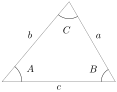
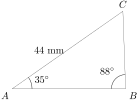
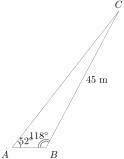
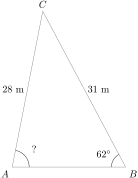
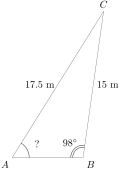
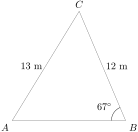
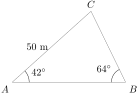
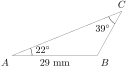
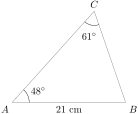
Let \(A, B, C\) be the measures of the angles of a triangle, and let \(a, b, c\) be the lengths of the sides opposite those angles, respectively. Then,
By convention, you should always label the triangle to align with the law of sines, so that each side letter is opposite its angle letter. In other words, side \(a\) is opposite angle \(A\text{,}\) side \(b\) is opposite angle \(B\text{,}\) and side \(c\) is opposite angle \(C\text{.}\)
Subsection8.1.1Placeholder Formulas in Trigonometry
When using the law of sines, the letters don’t dictate a specific angle or side. You could swap \(A\) and \(C\) and the formula would still be valid. You just have to swap \(a\) and \(c\) also. The only requirement is that \(a\) must be the side across from angle \(A\text{,}\)\(b\) across from \(B\text{,}\) and \(c\) across from \(C\text{.}\)
This means that law of sines is a so-called “placeholder formula”, in that the symbols \(A, B, C\) and \(a, b, c\) do not necessarily refer to specific sides or angles. They are just placeholders or “stand-ins” for the 3 sides and angles of a triangle. In contrast, some formulas use variables that have a universally agreed-upon meaning. For example, in the quadratic formula,
\begin{equation*}
ax^2 + bx + c = 0 \quad \rightarrow \quad x = \frac{-b \pm \sqrt{b^2 - 4ac}}{2a}
\end{equation*}
The letter \(a\) always represents the coefficient of \(x^2\text{,}\)\(b\) is the coefficient of \(x\text{,}\) and \(c\) is the constant. You can’t switch \(a\) and \(b\) without changing the meaning of the formula.