Triangle \(ABC\) has \(a = 8\text{,}\) \(b = 7\text{,}\) and \(A = 39°\text{.}\) Find all missing sides and angles, rounding to one decimal place as needed.
Section 8.4 Oblique Triangles Summary
Subsection 8.4.1 Summary of Solving Oblique Triangles
A good guideline is that for your first step, in short,
-
If you know a side-angle pair (side length and its opposite angle), use the law of sines.
-
Otherwise, use the law of cosines.
More precisely, here are the first steps to take based on what information you have,
| Type | First steps | |
|---|---|---|
| Two angles and non-included side | AAS | law of sines |
| Two angles and included side | ASA | solve for remaining angle, then law of sines |
| Two sides and opposite angle | SSA | law of sines |
| Two sides and included angle | SAS | law of cosines (solve for side first) |
| Three sides | SSS | law of cosines (solve for an angle first) |
Some additional notes:
-
Remember: If you know 2 angles, you can solve for the 3rd! Just subtract 180 minus the other two angles.
-
If it is a right triangle, then remember that you can simply use SOH-CAH-TOA! No need to use law of sines or law of cosines.
-
The SSA case also can be the ambiguous case if the triangle structure is unknown, with possibly 2, 1, or 0 solutions.
-
Be careful with rounding in intermediate steps, because it can lead to bigger rounding error in future calculations. A good guideline is to round intermediate calculations to at least 1 more decimal place than what the final answer asks for. So, if the final answer should be rounded to 1 decimal place, keep at least 2 decimal places your calculations, until the end.
-
Here is a triangle solver, which you can use to check your answers: Triangle Solver.
Subsection 8.4.2 Examples
Example 8.4.1.
Example 8.4.2.
A surveyor is mapping a plot of land. From their position, they determine it is 1200 feet to a post that marks the property border. The surveyor then turns by 72° to see an oak tree, which marks another corner of the property, that is 1800 feet away. What is the distance between the post and the oak tree? Hint: law of cosines.
Example 8.4.3.
Matt measures the angle of elevation of the peak of a mountain as \(35°\text{.}\) Susie, who is 1200 feet closer on a straight level path, measures the angle of elevation as \(42°\text{.}\) How high is the mountain?
Example 8.4.4.
A bicycle wheel has a radius of 35 cm. The wheel’s spokes are evenly spaced so that each pair of adjacent spokes forms a \(30°\) angle at the center. Find the distance between two adjacent spokes where they meet the rim. Hint: law of sines (or law of cosines). Answer: 18.1 cm.
Example 8.4.5.
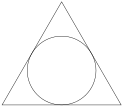
A circle with radius 4 cm is inscribed in an equilateral triangle. Find the side length of the triangle. Hint: an equilateral triangle has angles of \(60°\text{.}\) Answer: \(8\sqrt{3}\) cm.
Example 8.4.7.
A clock has an hour hand of length 12 cm and a minute hand of length 15 cm. Find the distance between the tips of the two hands when it is 4:00. Hint: At 4:00, the minute hand points straight up and the hour hand points at \(120°\) from the minute hand. Use the law of cosines. Answer: about 23.4 cm.

